


Page 58 - IJB-2-2
P. 58
Rheological study on 3D printability of alginate hydrogel and effect of graphene oxide

                     (a)                                      (b)  0.35
                       0.6     Alg10                                                    Alg10
                               GO0.05/Alg10                                             GO0.05/Alg10
                               GO0.15/Alg10                                             GO0.15/Alg10
                               GO0.25/Alg10                      0.30                   GO0.25/Alg10
                       0.5
                      Width (cm)  0.4                           Height (cm)  0.25


                       0.3                                       0.20


                       0.2                                       0.15
                             0     5      10    15     20              0     5     10     15     20
                                     Time (min)                                Time (min)

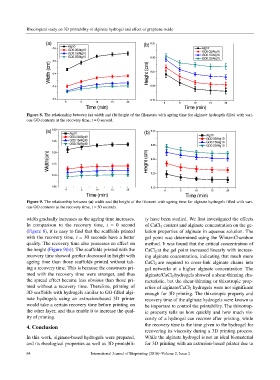
            Figure 8. The relationship between (a) width and (b) height of the filaments with ageing time for alginate hydrogels filled with vari-
            ous GO contents at the recovery time, t = 0 second.

                    (a) 0.30                                  (b)  0.35
                               Alg10
                               GO0.05/Alg10                                              Alg10
                                                                                         GO0.05/Alg10
                       0.25    GO0.15/Alg10                                              GO0.15/Alg10
                               GO0.25/Alg10                      0.30                    GO0.25/Alg10
                       0.20
                      Width(cm)  0.15                           Height (cm)  0.25


                       0.10                                      0.20

                       0.05                                      0.15
                             0     5      10    15     20              0      5     10     15    20
                                      Time (min)                                Time (min)

            Figure 9. The relationship between (a) width and (b) height of the filament with ageing time for alginate hydrogels filled with vari-
            ous GO contents at the recovery time, t = 30 seconds.

            width gradually increases as the ageing time increases.   ty have been studied. We first investigated the effects
            In comparison  to the recovery time,  t  = 0  second   of CaCl 2 content and alginate concentration on the ge-
            (Figure 8), it is easy to find that the scaffolds printed   lation properties of alginate in aqueous solution. The
            with the recovery time, t = 30 seconds have a better   gel point was determined using the Winter-Chambon
            quality. The recovery time also possesses an effect on   method. It was found that the critical concentration of
            the height (Figure 9(b)). The scaffolds printed with the   CaCl 2 at the gel point increased linearly with increas-
            recovery time showed gentler decreased in height with   ing alginate concentration, indicating that much more
            ageing time than those scaffolds printed without tak-  CaCl 2  are required  to cross-link  alginate chains into
            ing a recovery time. This is because the constructs pri-  gel networks at  a higher  alginate concentration. The
            nted with the recovery  time  were  stronger,  and thus   alginate/CaCl 2 hydrogels showed a shear-thinning cha-
            the spread effect became less obvious than those pri-  racteristic, but the shear-thinning or thixotropic prop-
            nted without  a recovery time.  Therefore, printing  of   erties of alginate/CaCl 2 hydrogels were not significant
            3D scaffolds with hydrogels similar to GO-filled algi-  enough for 3D printing. The thixotropic property and
            nate  hydrogels using an extrusion-based 3D  printer   recovery time of the alginate hydrogels were known to
            would take a certain recovery time before printing on   be important to control the printability. The thixotrop-
            the other layer, and thus enable it to increase the qual-  ic property tells us how quickly and how  much vis-
            ity of printing.                                   cosity of a hydrogel can recover after printing, while

            4. Conclusion                                      the recovery time is the time given to the hydrogel for
                                                               recovering its viscosity during a 3D printing process.
            In this work, alginate-based hydrogels were prepared,   While the alginate hydrogel is not an ideal biomaterial
            and its rheological properties as well as 3D printabili-  for 3D printing with an extrusion-based printer due to

            64                          International Journal of Bioprinting (2016)–Volume 2, Issue 2

