


Page 53 - IJB-2-2
P. 53
Huijun Li, Sijun Liu and Lin Li


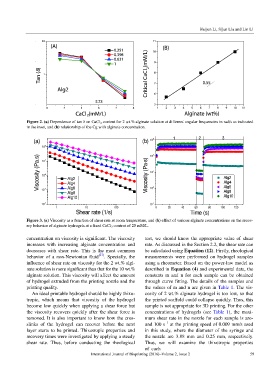
            Figure 2. (a) Dependence of tan δ on CaCl 2  content for 2 wt.% alginate solution at different angular frequencies in rad/s as indicated
            in the inset, and (b) relationship of the Cg with alginate concentration.

               (a)                                           (b)  10 3     1          2        3
                   10 2                                          10 2

                 Viscosity (Pa.s)  10 1 0   Alg2                Viscosity (Pa⋅s)  10 1           Alg2


                   10
                                                                                                 Alg4
                              Alg4
                              Alg6
                   10
                    -1
                                                                                                 Alg8
                              Alg8                               10 0                            Alg6
                              Alg10                                                              Alg10
                   10 -2                                         10 -1
                         1           10          100               0    20    40    60   80    100   120
                                 Shear rate (1/s)                                 Time (s)
            Figure 3. (a) Viscosity as a function of shear rate at room temperature, and (b) effect of various alginate concentrations on the recov-
            ery behavior of alginate hydrogels at a fixed CaCl 2  content of 25 mM/L.
            concentration on viscosity is significant. The viscosity   test,  we should  know  the appropriate value of  shear
            increases  with  increasing alginate concentration and   rate. As discussed in the Section 2.2, the shear rate can
            decreases  with  shear  rate. This is the  most common   be calculated using Equation (12). Firstly, rheological
            behavior  of a  non-Newtonian fluid [27] . Specially, the   measurements were performed  on  hydrogel samples
            influence of shear rate on viscosity for the 2 wt.% algi-  using  a  rheometer.  Based  on the  power-law  model as
            nate solution is more significant than that for the 10 wt.%   described in Equation (4) and  experimental data,  the
            alginate solution. This viscosity will affect the amount   constants  m  and  n  for  each  sample can  be obtained
            of hydrogel extruded from the printing nozzle and the   through  curve  fitting.  The details of  the samples  and
            printing quality.                                  the values  of  m  and  n  are given  in  Table  1. The  vis-
               An ideal printable hydrogel should be highly thixo-  cosity of 2 wt.% alginate hydrogel is too low, so that
            tropic,  which  means that viscosity  of the hydrogel   the printed scaffold could collapse quickly. Thus, this
            become low quickly when applying a shear force but   sample is not appropriate for 3D printing. For the other
            the viscosity recovers quickly after the shear force is   concentrations  of  hydrogels  (see Table 1),  the maxi-
            removed. It is also important to know how the cros-  mum  shear rate in  the  nozzle for  each  sample is  aro-
                                                                       –1
            slinks of the hydrogel can recover before the next   und 100 s  at the printing speed of 0.009 mm/s used
            layer starts to be printed.  Thixotropic  properties  and   in  this  study,  where  the  diameter  of  the  syringe  and
            recovery times were investigated by applying a steady   the nozzle are 3.88  mm and 0.25 mm, respectively.
            shear  rate. Thus, before conducting the rheological   Thus, we will examine the thixotropic properties
                                                               of each
                                        International Journal of Bioprinting (2016)–Volume 2, Issue 2      59

