


Page 52 - IJB-2-2
P. 52
Rheological study on 3D printability of alginate hydrogel and effect of graphene oxide

            layer. Subsequent layers were added layer-by-layer in   the gel point: both G'(ω) and G"(ω) are proportional to
            the vertical axis.                                 ωn (0 < n < 1) at sufficiently low frequencies, ω. The
                                                               definition of the gel point by this power-law is excel-
            3. Results and Discussion                          lent because the gelation variable will lose its depen-

            3.1 Sol-gel Transition                             dency of frequency at  the  gel point. Several works
                                                               have shown that this method is reliable and valid for
            Alginate is able to form a gel in the presence of CaCl 2.   determination of the gel point for various polymer
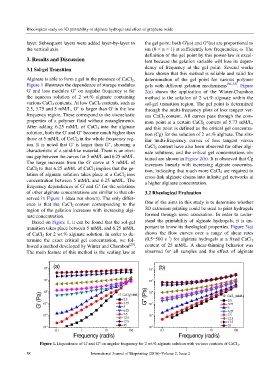
            Figure 1 illustrates the dependence of storage modulus   gels with different gelation  mechanisms [30–33] .  Figure
            G'  and  loss  modules  G"  on  angular  frequency  ω  for   2(a)  shows the  application  of the Winter-Chambon
            the aqueous  solution of 2 wt.% alginate containing   method to the solution of 2 wt.% alginate within the
            various CaCl 2 contents. At low CaCl 2 contents, such as   sol-gel transition region. The gel point is determined
            2.5, 3.75 and 5 mM/L, G" is larger than G' in the low   through the multi-frequency plots of loss tangent ver-
            frequency region. These correspond to the viscoelastic   sus CaCl 2  content. All curves pass  through the com-
            properties of a polymer fluid without entanglements.   mon point at a certain CaCl 2 content of 5.73 mM/L,
            After adding  6.25 mM/L of CaCl 2  into the alginate   and this point is defined as the critical gel concentra-
            solution, both the G' and G" become much higher than   tion (Cg) for the solution of 2 wt.% alginate. The sim-
            those at 5 mM/L of CaCl 2 in the whole frequency reg-  ilar multi-frequency curves of loss tangent versus
            ion. It is noted that G' is larger than G", showing a   CaCl 2 content have also been observed for other algi-
            characteristic of a solid-like material. There is an obvi-  nate solutions, and the critical gel concentrations ob-
            ous gap between the curves for 5 mM/L and 6.25 mM/L.   tained are shown in Figure 2(b). It is observed that Cg
            The  large increase from the G' curve at  5  mM/L of   increases linearly with increasing alginate concentra-
            CaCl 2 to that 6.25 mM/L of CaCl 2 implies that the ge-  tion, indicating that much more CaCl 2 are required to
            lation of alginate solution takes place at a CaCl 2 ions   cross-link alginate chains into infinite gel networks at
            concentration between 5 mM/L and 6.25 mM/L. The    a higher alginate concentration.
            frequency dependences of G' and G" for the solutions
            of other alginate concentrations are similar to that ob-  3.2 Rheological Evaluation
            served in Figure 1 (data not shown). The only differ-
            ence is that the CaCl 2  content  corresponding to the   One of the aims in this study is to determine whether
            region of the gelation increases with increasing algi-  3D extrusion printing could be used to print hydrogels
            nate concentration.                                formed through ionic  association. In  order to under-
               Based on Figure 1, it can be found that the sol-gel   stand the  printability  of  alginate hydrogels,  it is im-
            transition takes place between 5 mM/L and 6.25 mM/L   portant to know its rheological properties. Figure 3(a)
            of CaCl 2 for 2 wt.% alginate solution. In order to de-  shows the flow curves over a range of  shear rates
                                                                        –1
            termine  the exact  critical  gel  concentration, we  fol-  (0.5−500 s ) for alginate hydrogels at a fixed CaCl 2
            lowed a method developed by Winter and Chambon [29] .   content of  25  mM/L. A shear-thinning behavior  was
            The main feature of this method is the scaling law at     observed for  all samples and  the effect of alginate

                     2 (a)                                           (b)
                    10                                          10 2

                    10 1                                        10 1

                    10 0                              G'  CaCl (mM/L)  10 0                       G''  CaCl  (mM/L)
                  G' (Pa)  10 -1                      2.5  2     10 G'' (Pa)  -1                   2.5  2
                                                      3.75
                                                                                                   3.75
                                                      5
                                                      6.25                                         5
                                                                                                   6.25
                   10 -2                              7.5       10 -2                              7.5
                                                      12.5                                         12.5
                                                      17.5                                         17.5
                                                      25                                           25
                   10 -3                                        10 -3
                        0.1        1          10        100          0.1        1         10        100
                                Frequency (rad/s)                            Frequency (rad/s)

                  Figure 1. Dependence of G' and G" on angular frequency for 2 wt.% alginate solution with various contents of CaCl 2 .
            58                          International Journal of Bioprinting (2016)–Volume 2, Issue 2

