


Page 55 - IJB-2-2
P. 55
Huijun Li, Sijun Liu and Lin Li


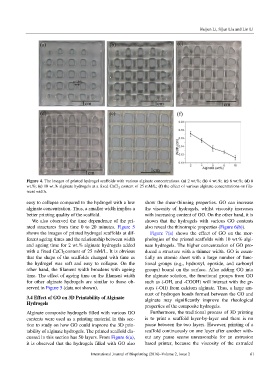
            Figure 4. The images of printed hydrogel scaffolds with various alginate concentrations. (a) 2 wt.%; (b) 4 wt.%; (c) 6 wt.%; (d) 8
            wt.%; (e) 10 wt.% alginate hydrogels at a fixed CaCl 2  content of 25 mM/L; (f) the effect of various alginate concentrations on fila-
            ment width.


            easy to collapse compared to the hydrogel with a low   show the shear-thinning properties.  GO  can increase
            alginate concentration. Thus, a smaller width implies a   the viscosity of  hydrogels, whilst  viscosity increases
            better printing quality of the scaffold.           with increasing content of GO. On the other hand, it is
               We also observed the time dependence of the pri-  shown that the hydrogels  with various  GO contents
            nted structures from time  0 to 20  minutes.  Figure 5   also reveal the thixotropic properties (Figure 6(b)).
            shows the images of printed hydrogel scaffolds at dif-  Figure 7(a)  shows the  effect  of GO on the  mor-
            ferent ageing times and the relationship between width   phologies of the printed scaffolds with 10 wt.% algi-
            and ageing time for 2 wt.% alginate hydrogels added   nate hydrogels. The higher concentration of GO pro-
            with a fixed CaCl 2 content of 25 mM/L. It is obvious   duced a structure with a thinner width. GO is essen-
            that the shape of the scaffolds changed with time as   tially an atomic sheet with a large  number of func-
            the  hydrogel was soft  and easy  to collapse. On the   tional groups (e.g.,  hydroxyl,  epoxide, and carbonyl
            other hand, the filament width broadens with ageing   groups) bound on the surface. After adding GO into
            time. The effect of ageing time on the filament width   the alginate solution, the functional groups from GO
            for other alginate hydrogels are similar to those  ob-  such as (-OH, and -COOH) will interact with the gr-
            served in Figure 5 (data not shown).               oups (-OH) from calcium alginate. Thus, a large am-
                                                               ount of hydrogen bonds formed between the GO and
            3.4 Effect of GO on 3D Printability of Alginate    alginate may significantly improve the rheological
            Hydrogels
                                                               properties of the composite hydrogels.
            Alginate composite hydrogels filled with various GO   Furthermore, the traditional process of 3D printing
            contents were used as a printing material in this sec-  is to print  a  scaffold layer-by-layer and there is  no
            tion to study on how GO could improve the 3D prin-  pause between the two layers. However, printing of a
            tability of alginate hydrogels. The printed scaffold dis-  scaffold continuously on one layer after another with-
            cussed in this section has 50 layers. From Figure 6(a),   out any pause seems unreasonable for  an extrusion
            it is observed that the hydrogels filled with GO also   based  printer, because the  viscosity of  the extruded

                                        International Journal of Bioprinting (2016)–Volume 2, Issue 2      61

