


Page 56 - IJB-2-2
P. 56
Rheological study on 3D printability of alginate hydrogel and effect of graphene oxide

            material maybe quickly decrease when being printed   recover more significantly with longer recovery time.
            and it needs a period of time to recover its viscosity.   After that, we found that the quality of printing was
            We here define the recovery time as the duration from   obviously improved, as proved by comparing the im-
            the finishing time of a current layer printed until the   ages of the printed scaffolds shown in Figure 7(b).
            printer starts to print and deposit a new layer on the   Figures 7(c) and (d) show the effect of GO content
            current layer. Therefore, it would be necessary to find   on the width and height of filaments at the recovery
            a reasonable recovery time that can improve the qual-  time, t = 0 and t = 30 seconds, respectively. It can be
            ity of printing.  Based on  the previous discussion in   seen that the width of filament with the recovery time,
            Section 3.2, a recovery time of 30 seconds was set as   t = 0 is bigger than that at the recovery time, t = 30
            the extruded hydrogels would recover most of its vis-  seconds. This is because that most of the hydrogel’s
            cosity after 30 seconds, and  the  viscosity could  not   viscosity  already recovered  after 30 seconds  of rest,


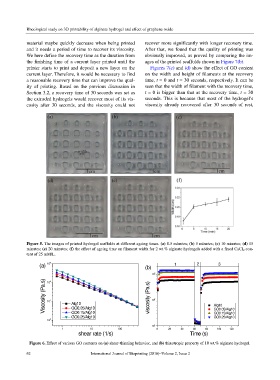
            Figure 5. The images of printed hydrogel scaffolds at different ageing times. (a) 0.5 minutes; (b) 5 minutes; (c) 10 minutes; (d) 15
            minutes; (e) 20 minutes; (f) the effect of ageing time on filament width for 2 wt.% alginate hydrogels added with a fixed CaCl 2  con-
            tent of 25 mM/L.

                  (a)  10 3                                    (b)         1         2        3
                                                                  10 3
                    Viscosity (Pa.s)  10 1   Alg10               viscosity (Pa.s)  10 2      Alg10
                      2
                     10


                                GO0.05/Alg10
                                GO0.15/Alg10
                                                                                             GO0.15/Alg10
                                GO0.25/Alg10                                                 GO0.05/Alg10
                                                                                             GO0.25/Alg10
                     10 0
                                                                  10 1
                           1           10          100              0    20   40   60   80   100   120
                                  shear rate (1/s)                                Time (s)

              Figure 6. Effect of various GO contents on (a) shear-thinning behavior, and (b) thixotropic property of 10 wt.% alginate hydrogel.
            62                          International Journal of Bioprinting (2016)–Volume 2, Issue 2

