


Page 54 - IJB-2-2
P. 54
Rheological study on 3D printability of alginate hydrogel and effect of graphene oxide

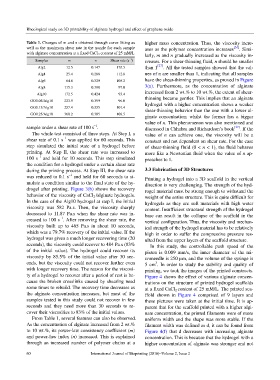
            Table 1. Changes of m and n obtained through curve fitting as   higher mass concentration. Thus, the viscosity incre-
            well as the maximum shear rate in the nozzle for each sample   ases as the polymer concentration increases [34] . Simi-
            with alginate concentration at a fixed CaCl 2  content of 25 mM/L   larly, m and n gradually increased as the viscosity in-
                                                        –1
                Samples       m          n      Shear rate (s )   creases. For a shear-thinning fluid, n should be smaller
                 Alg2        12.5       0.147      170.5       than 1 [27] . All the tested samples showed that the val-
                 Alg4        25.4       0.288      112.8       ues of n are smaller than 1, indicating that all samples
                 Alg6        64.8       0.329      105.2       have the shear-thinning properties, as proved in Figure
                 Alg8       115.3       0.390      97.0        3(a).  Furthermore,  as the  concentration of alginate
                 Alg10      172.5       0.424      93.4        increased from 2 wt.% to 10 wt.%, the extent of shear-
                                                               thinning became gentler. This implies that an alginate
              GO0.05/Alg10   223.9      0.399      96.0        hydrogel with a higher concentration shows a weaker
              GO0.15/Alg10   257.4      0.355      101.4       shear-thinning behavior than the one with a lower al-
              GO0.25/Alg10   360.2      0.305      109.5       ginate concentration; whilst the former has a bigger
                                                               value of n. This phenomenon was also mentioned and
                                         –1
            sample under a shear rate of 100 s .               discussed in Chhabra and Richardson’s book [27] . If the
               The whole test consisted of three steps. At Step I, a   value of  n  can achieve one, the viscosity will be a
                            –1
            shear rate of 0.1 s  was applied for 60 seconds. This   constant and not dependent on shear rate. For the case
            step simulated the initial state  of a hydrogel  before   of shear-thinning fluid (0 < n < 1), the fluid behaves
            printing. At Step II, the shear rate was  increased  to   more like a Newtonian fluid when the value of n ap-
                 –1
            100 s  and held for 10 seconds. This step simulated   proaches to 1.
            the condition for a hydrogel under a certain shear rate
            during the printing process. At Step III, the shear rate   3.3 Fabrication of 3D Structures
                              –1
            was reduced to 0.1 s  and held for 60 seconds to si-  Printing a hydrogel into a 3D scaffold in the vertical
            mulate a condition similar to the final state of the hy-  direction is very challenging. The strength of the hyd-
            drogel after printing. Figure 3(b) shows the recovery   rogel material must be strong enough to withstand the
            behavior of the viscosity of CaCl 2 /alginate hydrogels.   weight of the entire structure. This is quite difficult for
            In the case of the Alg10 hydrogel at step I, the initial   hydrogels as  they are soft  materials with high water
            viscosity was 582 Pa.s. Then,  the  viscosity sharply   content. Insufficient structural strength of the hydrogel
            decreased  to  11.87 Pa.s when  the shear rate was in-  base can result  in the collapse of the scaffold in the
                          –1
            creased to 100 s . After removing the shear rate, the   vertical configuration. Thus, the viscosity and mechan-
            viscosity built  up  to  465  Pa.s in about  10  seconds,   ical strength of the hydrogel material has to be relatively
            which was a 79.7% recovery of the initial value. If the   high in order to suffer the compressive pressure res-
            hydrogel was given a much longer recovering time (20   ulted from the upper layers of the scaffold structure.
            seconds), the viscosity could recover to 484 Pa.s (83%   In this study, the controllable push speed  of the
            of the initial  value). The hydrogel  could recover its   piston is  0.009 mm/s, the  inner diameter of the mi-
            viscosity by  85.5%  of the initial value  after 30 sec-  croneedle is 250 µm, and the volume of the syringe is
            onds, but the viscosity could not recover further even   5 cm . In order  to  study  the stability  and  quality of
                                                                   3
            with longer recovery time. The reason for the viscosi-  printing, we took the images of the printed constructs.
            ty of a hydrogel to recover after a period of rest is be-  Figure 4 shows the effect of various alginate concen-
            cause the broken crosslinks caused by shearing need   trations on the structure of printed hydrogel scaffolds
            some times to rebuild. The recovery time decreases as   at a fixed CaCl 2 content of 25 mM/L. The printed sca-
            the alginate concentration increases,  but most  of  the   ffold  shown in  Figure 4  comprised of 9 layers  and
            samples tested in this study could not recover in few   these pictures were taken at the initial time. It is ap-
            seconds  and they need more than 30 seconds to re-  parent that for the scaffold printed with a higher algi-
            cover their viscosities to 83% of the initial values.   nate concentration, the printed filaments were of more
               From Table 1, several features can also be observed.   uniform width and the shape was more stable. If the
            As the concentration of alginate increased from 2 wt.%   filament width was defined as d, it can be found from
            to 10 wt.%, its power-law consistency coefficient (m)   Figure 4(f)  that  d decreases with  increasing alginate
            and power-law index (n) increased. This is explained   concentration. This is because that the hydrogel with a
            through an increased number of polymer chains at a   higher concentration of alginate was stronger and not

            60                          International Journal of Bioprinting (2016)–Volume 2, Issue 2

