


Page 57 - IJB-2-2
P. 57
Huijun Li, Sijun Liu and Lin Li


                (c)  0.5                                     (d)  0.35

                                                t=0s
                   0.4
                                                t=30s           0.30
                  Width (cm)  0.3                                Height (cm)  0.25          t=0s


                   0.2


                   0.1                                          0.20                        t=30s
                                                                0.15
                       0.00  0.05  0.10  0.15  0.20  0.25  0.30      0.00  0.05  0.10  0.15  0.20  0.25  0.30
                                    GO (wt%)                                     GO (wt%)

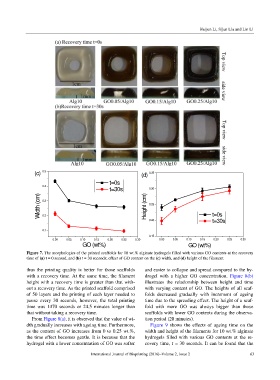
            Figure 7. The morphologies of the printed scaffolds for 10 wt.% alginate hydrogels filled with various GO contents at the recovery
            time of (a) t = 0 second, and (b) t = 30 seconds; effect of GO content on the (c) width, and (d) height of the filament.

            thus  the  printing  quality is better for those scaffolds   and easier to collapse and spread compared to the hy-
            with a recovery time. At the same time, the filament   drogel with a higher GO concentration.  Figure 8(b)
            height with a recovery time is greater than that with-  illustrates the relationship  between  height and time
            out a recovery time. As the printed scaffold comprised   with varying content of GO. The heights of all scaf-
            of 50 layers and the printing of each layer needed to   folds  decreased gradually with increment of  ageing
            pause every 30 seconds, however,  the  total printing   time due to the spreading effect. The height of a scaf-
            time  was  1470  seconds or 24.5  minutes longer than   fold with  more GO was always bigger than  those
            that without taking a recovery time.               scaffolds with lower GO contents during the observa-
               From Figure 8(a), it is observed that the value of wi-  tion period (20 minutes).
            dth gradually increases with ageing time. Furthermore,   Figure 9  shows the effects of  ageing  time on  the
            as the content of GO increases from 0 to 0.25 wt.%,   width and height of the filaments for 10 wt.% alginate
            the time effect becomes gentle. It is because that the   hydrogels filled with various GO contents at  the re-
            hydrogel with a lower concentration of GO was softer   covery time, t = 30 seconds. It can be found that the

                                        International Journal of Bioprinting (2016)–Volume 2, Issue 2      63

