


Page 426 - IJB-10-5
P. 426
International Journal of Bioprinting                                     Stability of 3D-printed PEO tablets


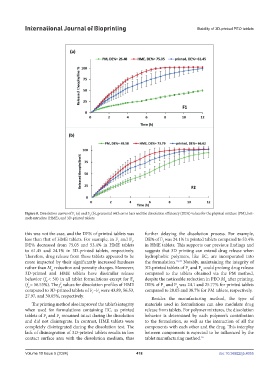
            Figure 8. Dissolution curves of F  (a) and F  (b), presented with error bars and the dissolution efficiency (DE%) values for the physical mixture (PM), hot-
                                       2
                                 1
            melt extrudate (HME), and 3D-printed tablets.
            this was not the case, and the DE% of printed tablets was   further delaying the dissolution process. For example,
            less than that of HME tablets. For example, in F  and F ,   DE% of F  was 24.1% in printed tablets compared to 53.4%
                                                   1
                                                         3
                                                                      3
            DE% decreased from 75.05 and 53.4% in HME tablets   in HME tablets. This supports our previous findings and
            to 61.45 and 24.1% in 3D-printed tablets, respectively.   suggests that 3D printing can extend drug release when
            Therefore, drug release from these tablets appeared to be   hydrophobic polymers, like EC, are incorporated into
            more impacted by their significantly increased hardness   the formulation. 16,26  Notably, maintaining the integrity of
            rather than M  reduction and porosity changes. Moreover,   3D-printed tablets of F  and F  could prolong drug release
                       w
                                                                                       4
                                                                                 3
            3D-printed and HME tablets have dissimilar release   compared to the tablets obtained via the PM method,
            behavior (f < 50) in all tablet formulations except for F    despite the noticeable reduction in PEO M  after printing.
                     2
                                                          2
                                                                                                 w
            (f = 56.53%). The f  values for dissolution profiles of HME   DE% of F  and F  was 24.1 and 25.77% for printed tablets
                           2
                                                                            4
             2
                                                                       3
            compared to 3D-printed tablets of F –F  were 43.89, 56.53,   compared to 28.05 and 38.7% for PM tablets, respectively.
                                        1
                                           4
            27.97, and 30.05%, respectively.
                                                                  Besides  the  manufacturing  method,  the  type  of
               The printing method also improved the tablet’s integrity   materials used in formulations can also modulate drug
            when used for formulations containing EC, as printed   release from tablets. For polymer mixtures, the dissolution
            tablets of F  and F  remained intact during the dissolution   behavior is determined by each polymer’s contribution
                     3
                          4
            and did not disintegrate. In contrast, HME tablets were   to the formulation, as well as the interaction of all the
            completely disintegrated during the dissolution test. The   components with each other and the drug. This interplay
            lack of disintegration of 3D-printed tablets results in low   between components is expected to be influenced by the
            contact surface area with the dissolution medium, thus   tablet manufacturing method. 16
            Volume 10 Issue 5 (2024)                       418                                doi: 10.36922/ijb.4055

