


Page 574 - IJB-10-5
P. 574
International Journal of Bioprinting                              ML-generated GelMA compression database


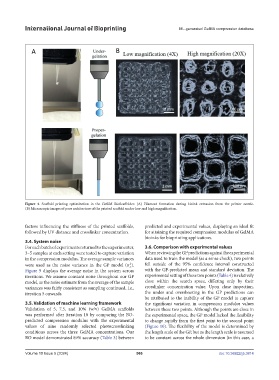
            Figure 4.  Scaffold  printing  optimization  in  the  GeSiM  BioScaffolder.  (A)  Filament  formation  during  bioink  extrusion  from  the  printer  nozzle.
            (B) Microscopic images of pore architecture of the printed scaffold under low and high magnification.


            factors  influencing  the  stiffness  of  the  printed  scaffolds,   predicted and experimental values, displaying an ideal fit
            followed by UV distance and crosslinker concentration.  for attaining the required compression modulus of GelMA
                                                               bioinks for bioprinting applications.
            3.4. System noise
            For each batch of experiments returned to the experimenter,   3.6. Comparison with experimental values
            3–5 samples at each setting were tested to capture variation   When reviewing the GP predictions against the experimental
            in the compression modulus. The average sample variances   data used to train the model (as a sense check), two points
            were  used  as the  noise  variance  in the GP  model  (σ ).   fell outside of the 95% confidence interval constructed
                                                        2
                                                        n
            Figure 9 displays the average noise in the system across   with the GP-predicted mean and standard deviation. The
            iterations. We assume constant noise throughout our GP   experimental setting of these two points (Table 4) is relatively
            model, as the noise estimate from the average of the sample   close within the search space, differing only by their
            variances was fairly consistent as sampling continued, i.e.,   crosslinker concentration value. Upon close inspection,
            iteration 5 onwards.                               the under and overshooting in the GP predictions can
                                                               be attributed to the inability of the GP model to capture
            3.5. Validation of machine learning framework      the significant variation in compression modulus values
            Validation of 5, 7.5, and 10% (w/v) GelMA scaffolds   between these two points. Although the points are close in
            was performed after iteration 10 by comparing the BO-  the experimental space, the GP model lacked the flexibility
            predicted compression modulus with the experimental   to change rapidly from the first point to the second point
            values  of  nine  randomly  selected  photocrosslinking   (Figure 10). The flexibility of the model is determined by
            conditions across the three GelMA concentrations. Our   the length scale of the GP, but as the length scale is assumed
            BO model demonstrated 89% accuracy (Table 3) between   to be constant across the whole dimension (in this case, a


            Volume 10 Issue 5 (2024)                       566                                doi: 10.36922/ijb.3814

