


Page 583 - IJB-10-6
P. 583
International Journal of Bioprinting                            Biomechanical analysis of mandibular implants


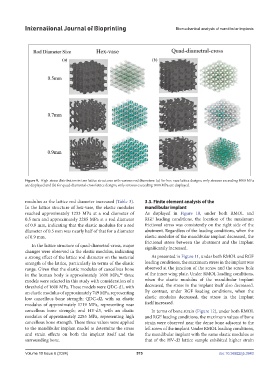
            Figure 9.  High-stress distribution in two lattice structures with various rod diameters: (a) for hex-vase lattice designs, only stresses exceeding 1000 MPa
            are displayed and (b) for quad-diametral-cross lattice designs, only stresses exceeding 1000 MPa are displayed.


            modulus as the lattice rod diameter increased (Table 3).   3.3. Finite element analysis of the
            In the lattice structure of hex-vase, the elastic modulus   mandibular implant
            reached approximately 1233 MPa at a rod diameter of   As displayed in  Figure 10, under both RMOL and
            0.5 mm and approximately 2285 MPa at a rod diameter   RGF loading conditions, the location of the maximum
            of 0.9 mm, indicating that the elastic modulus for a rod   frictional stress was consistently on the right side of the
            diameter of 0.5 mm was nearly half of that for a diameter   abutment. Regardless of the loading conditions, when the
            of 0.9 mm.                                         elastic modulus of the mandibular implant decreased, the
                                                               frictional stress between the abutment and the implant
               In the lattice structure of quad-diametral-cross, major   significantly increased.
            changes were observed in the elastic modulus, indicating
            a strong effect of the lattice rod diameter on the material   As presented in Figure 11, under both RMOL and RGF
            strength of the lattice, particularly in terms of the elastic   loading conditions, the maximum stress in the implant was
            range. Given that the elastic modulus of cancellous bone   observed at the junction of the screw and the screw hole
            in the human body is approximately 1600 MPa,  three   of the inner wing plate. Under RMOL loading conditions,
                                                    22
            models were selected in this study with consideration of a   when the elastic modulus of the mandibular implant
            threshold of 1600 MPa. These models were QDC-d1, with   decreased, the stress in the implant itself also decreased.
            an elastic modulus of approximately 749 MPa, representing   By  contrast,  under  RGF  loading  conditions,  when  the
            low cancellous bone strength; QDC-d2, with an elastic   elastic  modulus  decreased,  the  stress  in  the  implant
            modulus of approximately 1719 MPa, representing near   itself increased.
            cancellous bone strength; and HV-d3, with an elastic   In terms of bone strain (Figure 12), under both RMOL
            modulus of approximately 2285 MPa, representing high   and RGF loading conditions, the maximum values of bone
            cancellous bone strength. These three values were applied   strain were observed near the dense bone adjacent to the
            to the mandibular implant model to determine the stress   left screw of the implant. Under RMOL loading conditions,
            and  strain  effects  on  both  the  implant  itself  and  the   the mandibular implant with the same elastic modulus as
            surrounding bone.                                  that of the HV-d3 lattice sample exhibited higher strain

            Volume 10 Issue 6 (2024)                       575                                doi: 10.36922/ijb.3943

