


Page 119 - IJB-7-3
P. 119
Li, et al.
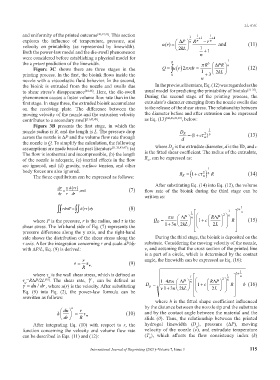
           and uniformity of the printed outcome [40,42,43] . This section        1  1    1
           explores  the  influence  of  temperature,  pressure,  and         P  n  R n 1   r n 1   and   (11)
           velocity  on  printability  (as  represented  by  linewidth).   ur()    2 kL    1
           Both the power-law model and the die-swell phenomenon                      n  1
           were considered before establishing a physical model for
           the a priori prediction of the linewidth.                      R             R   PR  1 n
                                                                                         3

                                                                           u r
               Figure  3C shows there  are  three  stages in the      Q  2   rdr                   (12)
           printing process. In the first, the bioink flows inside the    0            1   3   2 kL
           nozzle with a viscoelastic fluid behavior. In the second,                   n
           the  bioink is extruded  from the  nozzle  and  swells due   In the previous literature, Eq. (12) was regarded as the
           to shear stress’s disappearance [44-48] . Here, the die-swell   usual model for predicting the printability of bioinks [31-33] .
           phenomenon causes a faster volume flow rate than in the   During the second stage of the printing process, the
           first stage. In stage three, the extruded bioink accumulates   extrudate’s diameter emerging from the nozzle swells due
           on  the  receiving  plate.  The  difference  between  the   to the release of the shear stress. The relationship between
           moving velocity of the nozzle and the extrusion velocity   the diameter before and after extrusion can be expressed
           contributes to a secondary swell [31,43,49] .       as Eq. (13) [44,46,49,50] , below:
               Figure  3B  presents  the  first  stage,  in  which  the
           nozzle radius is R, and the length is L. The pressure drop         D E         1               (13)
           across the nozzle is ∆P and the volume flow rate through           d   (1   c w 2 6
                                                                                         )
           the nozzle is Q. To simplify the calculation, the following
           assumptions are made based on past literature [31,33,43,47] : (a)   where D  is the extrudate diameter, d is the ID, and c
                                                                          E
           The flow is isothermal and incompressible, (b) the length   is the fitted shear coefficient. The radius of the extrudate,
           of the nozzle is adequate, (c) inertial effects in the flow   R , can be expressed as:
                                                                E
           are ignored, and (d) gravity, surface tension, and other
           body forces are also ignored.                                              2 6 1  R          (14)
                                                                                     c
               The force equilibrium can be expressed as follows:            R   1   w
                                                                               E
                                                                   After substituting Eq. (14) into Eq. (12), the volume
                          dP    1  dr               (7)    flow  rate  of  the  bioink  during  the  third  stage  can  be
                          dy  r  dr  ,and
                                                               written as:
                          rdrdP   d r     dy    (8)                       1              1   3 3  1 n

                                                                         n   P          2   6
                                                                                           RP
                                                                                  n
               where P is the pressure, r is the radius, and τ is the         Q       1  c        R     (15)
                                                                    E


           shear stress. The left-hand side of Eq. (7) represents the   13 n  2 kL       2 L
           pressure difference along the y axis, and the right-hand
           side shows the distribution of the shear stress along the   During the third stage, the bioink is deposited on the
           r axis. After the integration concerning r and scale dP/dy   substrate. Considering the moving velocity of the nozzle,
           with ∆P/L, Eq. (9) is derived:                      v, and assuming that the cross section of the printed line
                                                               is a part of a circle, which is determined by the contact
                                    r                          angle, the linewidth can be expressed as Eq. (16):
                                                     (9)
                                    R  w,
               where τ  is the wall shear stress, which is defined as                            1    3  1 n
                      w
                                                                                  1
           τ =R∆P/2L .  The  shear  rate,  γ ,  can  be  defined  as   14 n   P         2   6
                    [49]
                                                                                          RP
                                                                                  n
           w
             du dr/  , where u(r) is the velocity. After substituting   D   v     kL    1  c   L       R   b  (16)
                                                                 p

           Eq.  (9)  into  Eq.  (2),  the  power-law  formula  can  be   13 n  2       2
           rewritten as follows:
                                                                   where b is the fitted shape coefficient influenced
                            du  n  r                         by the distance between the nozzle tip and the substrate
                         k         w               (10)    and by the contact angle between the material and the
                             dr   R                          slide (θ).  Thus,  the  relationship  between  the  printed
               After  integrating  Eq.  (10)  with  respect  to r, the   hydrogel linewidth (D ),  pressure  (∆P), moving
                                                                                     p
           function  concerning  the  velocity  and  volume  flow  rate   velocity of the nozzle (v), and extrudate temperature
           can be described in Eqs. (11) and (12):             (T ),  which  affects  the  flow  consistency  index  (k)
                                                                E
                                       International Journal of Bioprinting (2021)–Volume 7, Issue 3       115

