


Page 136 - IJB-8-2
P. 136
3D Printing of Hollow Microneedle Patches
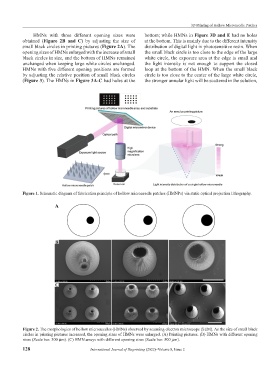
               HMNs  with  three  different  opening  sizes  were   bottom; while HMNs in Figure 3D and E had no holes
           obtained  (Figure  2B  and  C)  by adjusting  the  size  of   at the bottom. This is mainly due to the different intensity
           small black circles in printing pictures (Figure 2A). The   distribution of digital light in photosensitive resin. When
           opening sizes of HMNs enlarged with the increase of small   the small black circle is too close to the edge of the large
           black circles in size, and the bottom of HMNs remained   white circle, the exposure area at the edge is small and
           unchanged when keeping large white circles unchanged.   the  light  intensity  is not enough to support the  closed
           HMNs with five different opening positions are formed   loop at the bottom of the HMN. When the small black
           by adjusting the relative position of small black circles   circle is too close to the center of the large white circle,
           (Figure 3). The HMNs in Figure 3A-C had holes at the   the stronger annular light will be scattered in the solution,


           Figure 1. Schematic diagram of fabrication principle of hollow microneedle patches (HMNPs) via static optical projection lithography.


                        A


                         B


                        C


           Figure 2. The morphologies of hollow microneedles (HMNs) observed by scanning electron microscope (SEM). As the size of small black
           circles in printing pictures increased, the opening sizes of HMNs were enlarged. (A) Printing pictures. (B) HMNs with different opening
           sizes (Scale bar: 300 μm). (C) HMN arrays with different opening sizes (Scale bar: 500 μm).

           128                         International Journal of Bioprinting (2022)–Volume 8, Issue 2

