


Page 137 - IJB-8-2
P. 137
Li, et al.
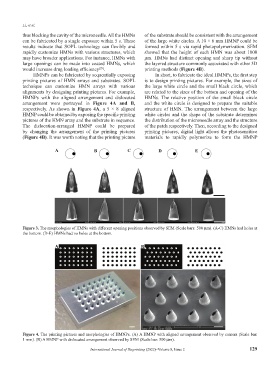
           thus blocking the cavity of the microneedle. All the HMNs   of the substrate should be consistent with the arrangement
           can be fabricated by a single exposure within 5 s. These   of the large white circles. A 10 × 6 mm HMNP could be
           results  indicate  that  SOPL  technology  can  flexibly  and   formed within 5 s via rapid photopolymerization. SEM
           rapidly customize HMNs with various structures, which   showed that  the  height  of each HMN was about  1000
           may have broader applications. For instance, HMNs with   μm. HMNs had distinct opening and sharp tip without
           large openings can be made into coated HMNs, which   the layered structure commonly associated with other 3D
           would increase drug loading efficiency .            printing methods (Figure 4B).
                                           [29]
               HMNPs can be fabricated by sequentially exposing    In short, to fabricate the ideal HMNPs, the first step
           printing  pictures  of HMN arrays and  substrates.  SOPL   is to design printing pictures. For example, the sizes of
           technique  can  customize  HMN arrays  with  various   the large white circle and the small black circle, which
           alignments by designing printing pictures. For example,   are related to the sizes of the bottom and opening of the
           HMNPs  with the aligned arrangement  and dislocated   HMNs.  The  relative  position  of  the  small  black  circle
           arrangement  were portrayed in  Figure  4A  and  B,   and the white circle is designed to prepare the suitable
           respectively. As shown in  Figure  4A,  a  5  ×  8  aligned   structure of HMN. The arrangement between the large
           HMNP could be obtained by exposing the specific printing   white circles and the shape of the substrate determines
           pictures of the HMN array and the substrate in sequence.   the distribution of the microneedle array and the structure
           The dislocation-arranged HMNP could be prepared     of the patch respectively. Then, according to the designed
           by changing the arrangement  of the printing  pictures   printing pictures, digital light allows the photosensitive
           (Figure 4B). It was worth noting that the printing picture   materials  to rapidly polymerize  to form the HMNP

                        A                B             C            D               E


           Figure 3. The morphologies of HMNs with different opening positions observed by SEM (Scale bars: 500 μm). (A-C) HMNs had holes at
           the bottom. (D-E) HMNs had no holes at the bottom.

                        A                                    B


           Figure 4. The printing pictures and morphologies of HMNPs. (A) A HMNP with aligned arrangement observed by camera (Scale bar:
           1 mm). (B) A HMNP with dislocated arrangement observed by SEM (Scale bar: 500 μm).

                                       International Journal of Bioprinting (2022)–Volume 8, Issue 2       129

