


Page 138 - IJB-8-2
P. 138
3D Printing of Hollow Microneedle Patches
           without  layer-by-layer  structure.  As a  result,  SOPL   distance of about 250 μm and compression strength of
           technology enables rapid customization of high-quality   about 4 N. It was reported that insertion forces of 0.1 –
           HMNPs.                                              3 N were sufficient to permit insertion by hand . This
                                                                                                       [31]
                                                               reveals that the mechanical strength of HMNs is sufficient
           3.2. In vitro biocompatibility of HMNPs             for skin puncture.
           The safety issue of materials  used in 3D printing  was   3.4. Puncture experiment and skin healing
           controversial  and the biocompatibility of the printing
                      [30]
           ink should be evaluated. In this study, the cytotoxicity of   experiment on mouse skin
           the extract of printing material was used to assess the in   Good puncture ability  is critical for the microneedles
           vitro biocompatibility of HMNP. The printed 1 cm  cubes   to  pierce  stratum  corneum  and  to  assess  the  efficacy
                                                     3
           were processed according to section 2.4. Post-treatment   of transdermal  drug delivery. As shown in  Figure  7A,
           of HMNPs  for the extract, and then co-incubated  with   HMNPs  efficiently  penetrated  the  skin  of  mice,  as
           HaCaT and HDF cells. The relative cell viability of cells   evidenced by the H&E staining of tissue section with a
           incubated with the extract of 3D printing material had no   puncture depth of about 300 μm. The pores formed by
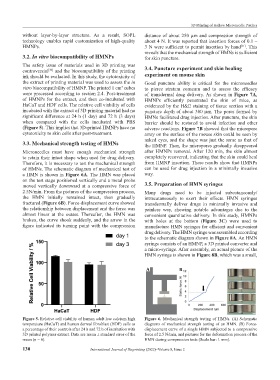
           significant difference at 24 h (1 day) and 72 h (3 days)   HMNs facilitated drug injection. After puncture, the skin
           when compared  with  the  cells  incubated  with  PBS   barrier  should be restored to avoid infection  and other
           (Figure 5). This implies that 3D-printed HMNPs have no   adverse reactions. Figure 7B showed that the micropore
           cytotoxicity to skin cells after post-treatment.    array on the surface of the mouse skin could be seen by
                                                               naked eyes, and the shape was just the same as that of
           3.3. Mechanical strength testing of HMNs            the HMNP. Then, the micropores gradually disappeared
           Microneedles must have enough mechanical  strength   after  HMNPs  removal. After  120  min,  the  skin  almost
           to retain their intact shape when used for drug delivery.   completely recovered, indicating that the skin could heal
           Therefore, it is necessary to test the mechanical strength   from HMNP insertion. These results show that HMNPs
           of HMNs. The schematic diagram of mechanical test of   can be used for drug injection in a minimally invasive
           a HMN is shown in Figure 6A. The HMN was placed     way.
           on the test stage positioned vertically and a metal probe
           moved  vertically  downward at  a compressive  force  of   3.5. Preparation of HMN syringes
           2.5N/min. From the pictures of the compression process,   Many drugs need to be injected  subcutaneously/
           the HMN initially  remained intact,  then gradually   intracutaneously  to  exert  their  effects.  HMN  syringes
           fractured (Figure 6B). Force-displacement curve showed   transdermally  deliver  drugs in minimally  invasive and
           the relationship between displacement and the force was   painless way, showing notable  advantages  due to the
           almost  linear  at the  outset.  Thereafter, the  HMN was   convenient quantitative delivery. In this study, HMNPs
           broken, the curve shook suddenly, and the arrow in the   with holes at the bottom (Figure  3C) were used to
           figure  indicated  its  turning  point  with  the  compression   manufacture HMN syringes for efficient and convenient
                                                               drug delivery. The HMN syringe was assembled according
                                                               to the schematic diagram shown in Figure 8A. An HMN
                                                               syringe consists of an HMNP, a 3D printed converter and
                                                               a micro-syringe. After assembly, an actual picture of the
                                                               HMN syringe is shown in Figure 8B, which was a small,


                                                               A             B


           Figure 5. Relative cell viability of human adult low calcium high   Figure 6. Mechanical strength testing of HMNs. (A) Schematic
           temperature (HaCaT) and human dermal fibroblast (HDF) cells as   diagrams of mechanical strength testing of an HMN. (B) Force-
           a percentage of their controls after 24 h and 72 h of incubation with   displacement curve of a single HMN subjected to a compressive
           3D printed polymer extract. Data are mean ± standard error of the   force of 2.5 N/min, and pictures for the deformation process of the
           mean (n = 6).                                       HMN during compression tests (Scale bar: 1 mm).

           130                         International Journal of Bioprinting (2022)–Volume 8, Issue 2

