


Page 47 - IJB-8-2
P. 47
Jiao, et al.
             A                                   C                                D


                                                                                  F

             B


                        E


                                                                                  G


             H                                               I


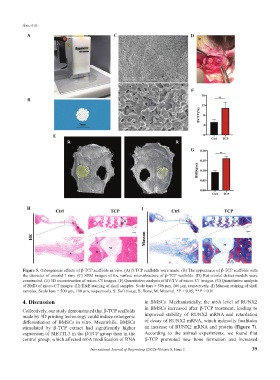
           Figure 5. Osteogenesis effects of β-TCP scaffolds in vivo. (A) β-TCP scaffolds were made. (B) The appearance of β-TCP scaffolds with
           the diameter of around 7 mm. (C) SEM images of the surface microstructure of β-TCP scaffolds. (D) Rat cranial defect models were
           constructed. (E) 3D reconstruction of micro-CT images. (F) Quantitative analysis of BV/TV of micro-CT images. (G) Quantitative analysis
           of BMD of micro-CT images. (H) H&E staining of skull samples. Scale bars = 500 μm, 100 μm, respectively. (I) Masson staining of skull
           samples. Scale bars = 500 μm, 100 μm, respectively. S: Soft tissue; B: Bone; M: Material. *P < 0.05; **P < 0.01

           4. Discussion                                       in BMSCs. Mechanistically, the m6A level of RUNX2
                                                               in  BMSCs  increased  after  β-TCP  treatment,  leading  to
           Collectively, our study demonstrated that β-TCP scaffolds
           made by 3D printing technology could induce osteogenic   improved  stability  of  RUNX2  mRNA  and  retardation
           differentiation of BMSCs in vitro. Meanwhile, BMSCs   of decay of RUNX2 mRNA, which indirectly facilitates
           stimulated  by  β-TCP  extract  had  significantly  higher   an increase of RUNX2 mRNA and protein (Figure 7).
           expression of METTL3 in the β-TCP group than in the   According  to  the  animal  experiments,  we  found  that
           control group, which affected m6A modification of RNA   β-TCP  promoted  new  bone  formation  and  increased

                                       International Journal of Bioprinting (2022)–Volume 8, Issue 2        39

