


Page 124 - IJB-8-3
P. 124
3D Scaffold for Combined Antibacterial and Antitumor Therapy


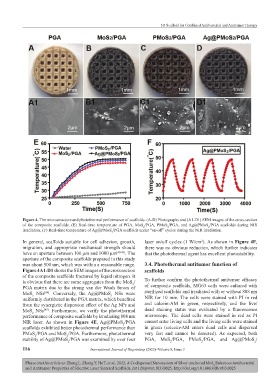
           Figure 4. The microstructure and photothermal performance of scaffolds. (A-D) Photographs and (A1-D1) SEM images of the cross-section
           of the composite scaffolds. (E) Real-time temperature of PGA, MoS /PGA, PMoS /PGA, and Ag@PMoS /PGA scaffolds during NIR
                                                                                          2
                                                              2
                                                                        2
           irradiation. (F) Real-time temperature of Ag@PMoS /PGA scaffolds under “on-off” cycles during the NIR irradiation.
                                                2
           In general, scaffolds suitable for cell adhesion, growth,   laser on/off cycles (1 W/cm ). As shown in Figure 4F,
                                                                                       2
           migration,  and  appropriate  mechanical  strength  should   there was no obvious reduction, which further indicates
           have an aperture between 100 μm and 1000 μm [40-43] . The   that the photothermal agent has excellent photostability.
           aperture of the composite scaffolds prepared in this study
           was about 500 um, which was within a reasonable range.   3.4. Photothermal antitumor function of
           Figure 4A1-D1 shows the SEM images of the cross section   scaffolds
           of the composite scaffolds fractured by liquid nitrogen. It
           is obvious that there are some aggregates from the MoS /  To further confirm the photothermal antitumor efficacy
                                                         2
           PGA matrix due to the strong van der Waals forces of   of composite scaffolds, MG63 cells were cultured with
           MoS  NSs .  Conversely,  the  Ag@PMoS  NSs  were    sterilized scaffolds and irradiated with or without 808 nm
                    [44]
                                                2
               2
           uniformly distributed in the PGA matrix, which benefited   NIR for 10 min. The cells were stained with PI in red
           from the synergistic dispersion effect of the Ag NPs and   and  calcein-AM  in  green,  respectively,  and  the  live/
           MoS  NSs . Furthermore, we verify the photothermal   dead  staining  status  was  evaluated  by  a  fluorescence
                    [45]
               2
           performance of composite scaffolds by irradiating 808 nm   microscope.  The dead cells were stained in red as PI
           NIR laser.  As shown in  Figure  4E,  Ag@PMoS /PGA   cannot enter living cells and the living cells were stained
                                                     2
           scaffolds exhibited better photothermal performance than   in  green  (calcein-AM enters  dead  cells  and  dispersed
           PMoS /PGA and MoS /PGA. Furthermore, photothermal   very  fast  and  cannot  be  detected).  As  expected,  both
                2
                             2
           stability of Ag@PMoS /PGA was examined by over four   PGA,  MoS /PGA,  PMoS /PGA,  and  Ag@PMoS /
                                                                         2
                                                                                       2
                                                                                                             2
                              2
           116                         International Journal of Bioprinting (2022)–Volume 8, Issue 3
            Please cite this article as: Zheng L, Zhong Y, He T, et al., 2022, A Codispersed Nanosystem of Silver-anchored MoS  Enhances Antibacterial
                                                                                            2
            and Antitumor Properties of Selective Laser Sintered Scaffolds, Int J Bioprint, 8(3):0025. http://doi.org/10.18063/ijb.v8i3.0025

