


Page 56 - IJB-8-3
P. 56
Additive Manufacturing of Bone Scaffolds
           3.2. Finite element modeling results                geometry presents a good match with the obtained load-
                                                               displacement curves determined from compression tests.
           First,  mesh  convergence  study  has  been  performed  for   However, as will be discussed further, the real geometry
           one compression test to define the optimum element size.   has led to more accurate results.
           Second,  the  results  of  load-displacement  curves  of  the   Two printed scaffolds, S3H and S10V, were chosen
           linear part of experiments have been compared with the   for µCT scan. The resolution of the reported STL files
           FEM results to evaluate and verify the accuracy of the
           FEM. The total force acting on the middle cross-section   was around 25 µ. However, due to the limitation of the
           of the scaffold has been extracted from the output file.   computational resources, a re-mesh strategy was adopted
           The FE model with the highest number of finite elements   so that the final resolution was in the range 80 – 125 µ.
           (around 5.2E+6 elements) has been assumed to provide   Specimens  3  and  10  were  scanned  using  µCT  and  the
           the  reference  solution,  and  the  other  cases  have  been   corresponding  numerical  model  for  the  FE  simulation
           compared  to  it. According  to  Figure  13,  the  optimum   was created using solid elements.
           mesh  has  been  identified  to  possess  around  2,000,000   The Von Mises stress contours show that scaffolds
           elements, leading to about 96.97% accuracy.         tend  to  fail  sooner  in  the  gyroid  section  than  in  both
               In Figure 14, the FEM results related to the nominal   I-WP and diamond sections. The comparison between
           and real geometry have been compared with experimental   I-WP and gyroid is not challenging because the latter
           results in the linear regime for specimen number 3 and   is  bending  dominated  while  the  first  one  is  stretching
           10,  in  subfigures  a  and  b,  respectively.  In  general,  the   dominated, meaning that I-WP structure is keen to fail
           linear response for both the scaffold’s nominal and real   under the buckling mechanism. As a consequence, the
                                                               I-WP  structure  fails  at  a  greater  load  value  than  the
                                                               gyroid  one.  However,  the  combination  of  gyroid  and
                                                               diamond structure requires a more detailed explanation
                                                               because  both  of  them  are  bending-dominated  TPMS
                                                               structures and the cell size and thickness are the same
                                                               for each part.
                                                                   According to Table 3, the porosity of gyroid and
                                                               diamond structures is 75.51% and 69.71%, respectively.
                                                               Based on the work of Ashby et al. , the more porous
                                                                                             [59]
                                                               the  scaffold,  the  lower  the  cellular  structure’s  strength
                                                               must  be.  Therefore,  apart  from  any  specific  geometry
                                                               and topology of gyroid and diamond structures, since the
                                                               gyroid is more porous than the diamond, it will fail sooner.
                                                               FEM model and experiments are in good agreement with
                                                               this  statement.  Specimen  10  has  such  a  structure  and
                                                               the FEM Von Mises stress results for both the real and
                                                               nominal geometry are shown in Figure 15.
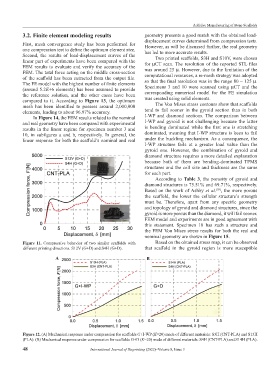
           Figure  11.  Compressive  behavior  of  two  similar  scaffolds  with   Based on the obtained stress map, it can be observed
           different printing directions. S12V (G+D) and S4H (G+D).  that  scaffold  in  the  gyroid  region  is  more  susceptible

                         A                                     B


           Figure 12. (A) Mechanical response under compression for scaffolds G+I-WP (K=20) made of different materials: S3H (CNT-PLA) and S13H
           (PLA). (B) Mechanical response under compression for scaffolds G+D (K=20) made of different materials: S4H (CNT-PLA) and S14H (PLA).

           48                          International Journal of Bioprinting (2022)–Volume 8, Issue 3

