


Page 69 - IJB-9-2
P. 69
International Journal of Bioprinting                                Bioprinting in wound dressing and healing


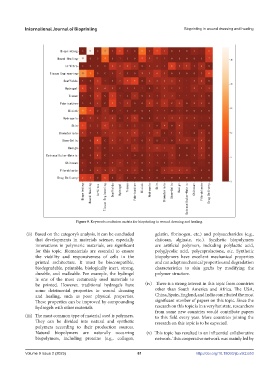
                                 Figure 9. Keywords confusion matrix for bioprinting in wound dressing and healing.

            (ii)  Based on the category’s analysis, it can be concluded   gelatin,  fibrinogen,  etc.)  and  polysaccharides  (e.g.,
                that developments in materials science, especially   chitosan, alginate, etc.). Synthetic biopolymers
                innovations  in  polymeric  materials,  are  significant   are artificial polymers, including polylactic acid,
                for this topic. Biomaterials are essential to ensure   polyglycolic acid, polycaprolactone, etc. Synthetic
                the viability and responsiveness of cells in the   biopolymers have excellent mechanical properties
                printed architecture. It must be biocompatible,    and can adapt mechanical properties and degradation
                biodegradable, printable, biologically inert, strong,   characteristics to skin grafts by modifying the
                durable, and malleable. For example, the hydrogel   polymer structure.
                is one of the most commonly used materials to
                be  printed.  However,  traditional  hydrogels  have   (iv)   There is a strong interest in this topic from countries
                some detrimental properties to wound dressing      other  than  South  America  and  Africa.  The  USA,
                and healing, such as poor physical properties.     China, Spain, England, and India contributed the most
                These properties can be improved by compounding    significant number of papers on this topic. Since the
                hydrogels with other materials.                    research on this topic is in a very hot state, researchers
                                                                   from some new countries would contribute papers
            (iii)  The most common type of material used is polymers.   to this field every year. More countries joining the
                They can be divided into natural and synthetic     research on this topic is to be expected.
                polymers according to their production sources.
                Natural biopolymers are naturally occurring     (v)  This topic has resulted in an influential collaborative
                biopolymers, including proteins (e.g., collagen,   network. This cooperative network was mainly led by


            Volume 9 Issue 2 (2023)                         61                       http://doi.org/10.18063/ijb.v9i2.653

