


Page 512 - IJB-9-5
P. 512
International Journal of Bioprinting                             Implantation of composites for cartilage repair


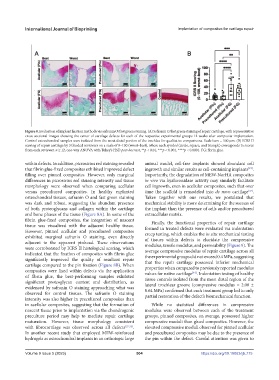
            Figure 8. Evaluation of implant fixation methods via safranin O/fast green staining. (A) Safranin O/fast green staining of repair cartilage, with representative
            cross-sectional images showing the center of cartilage defects for each of the respective experimental groups 12 weeks after composite implantation.
            Control osteochondral samples were isolated from the most distal portion of the trochlea for qualitative comparisons. Scale bars = 500 mm. (B) ICRS II
            scoring of repair cartilage by 3 blinded reviewers on a scale of 0–100 (worst–best), where each symbol (circle, square, and triangle) corresponds to scores
            from each reviewer. n ³ 12, one-way ANOVA with Tukey’s HSD post-hoc test, **p < 0.01, ***p < 0.001, ****p < 0.0001. FG: fibrin glue.


            within defects. In addition, picrosirius red staining revealed   animal model, cell-free implants showed abundant cell
            that fibrin glue-fixed composites exhibited improved defect   ingrowth and similar results as cell-containing implants .
                                                                                                           [43]
            filling over pinned composites. However, only marginal   Importantly, the degradation of MEW-NorHA composites
            differences in picrosirius red staining intensity and tissue   in vivo via hyaluronidase activity may similarly facilitate
            morphology were observed when comparing acellular   cell ingrowth, even in acellular composites, such that over
            versus  precultured  composites.  In  healthy  explanted   time the scaffold is remodeled into  de  novo cartilage .
                                                                                                           [37]
            osteochondral tissues, safranin O and fast green staining   Taken together with our results, we postulated that
            was dark and robust, suggesting the abundant presence   mechanical stability is more determining for the success of
            of both proteoglycans and collagen within the cartilage   the implant than the presence of cells and/or precultured
            and bone phases of the tissue (Figure 8A). In some of the   extracellular matrix.
            fibrin glue-fixed composites, the integration of nascent   Finally, the functional properties of repair cartilage
            tissue was visualized with the adjacent healthy tissue.   formed in treated defects were evaluated via indentation
            However, pinned acellular and precultured composites   creep testing, which enables the in situ mechanical testing
            exhibited marginal safranin O staining, even directly   of  tissues  within  defects  to  elucidate  the  compressive
            adjacent  to  the  apparent  pinhead.  These  observations   modulus, tensile modulus, and permeability (Figure 9). The
            were corroborated by ICRS II histological scoring, which   average compressive modulus of repair cartilage across all
            indicated that the fixation of composites with fibrin glue   the experimental groups did not exceed 0.4 MPa, suggesting
            significantly improved the quality of resultant repair   that  the repair  cartilage possessed  inferior  mechanical
            cartilage compared to the pin fixation (Figure 8B). When   properties when compared to previously reported modulus
            composites were fixed within defects via the application   values for native cartilage . Indentation testing of healthy
                                                                                   [44]
            of fibrin glue, the best-performing samples exhibited   tissue controls isolated from the most distal region of the
            significant proteoglycan content and distribution, as   lateral trochlear groove (compressive modulus  = 2.00 ±
            evidenced by safranin O staining approaching what was   0.64 MPa) confirmed that each treatment group led to only
            observed for control tissues. The safranin O staining   partial restoration of the defect’s biomechanical function.
            intensity was also higher in precultured composites than
            in acellular composites, suggesting that the formation of   While no statistical differences in compressive
            nascent tissue prior to implantation via the chondrogenic   modulus  were  observed  between  each  of  the  treatment
            preculture period may help to mediate repair cartilage   groups, pinned composites, on average, possessed higher
            maturation. However, tissue morphology consistent   compressive moduli than glued composites. However, the
            with fibrocartilage was observed across all defects [27,32] .   elevated compressive moduli observed for pinned acellular
            In another recent study that employed MEW-reinforced   and precultured composites may be due to the presence of
            hydrogels as osteochondral implants in an orthotopic large   the pin within the defect. Careful attention was given to


            Volume 9 Issue 5 (2023)                        504                         https://doi.org/10.18063/ijb.775

