


Page 54 - IJB-9-6
P. 54
International Journal of Bioprinting                           Sub-regional design of the bionic bone scaffolds


            Table 3. Values of a1 for different scale coefficients  taking the target aperture range and computational
                                                               efficiency into account. Besides, randomness was supposed
             C (%)      a  (μm)    r  (μm)    Davg (μm)        to be one of the possible influencing factors of the aperture
                         1
                                    1
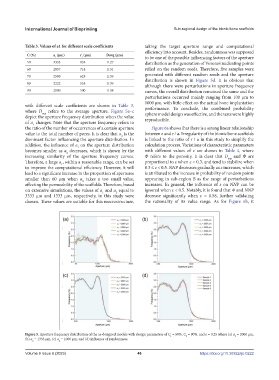
             50         3333       833        1127             distribution as the generation of Voronoi nucleating points
             60         2857       714        1131             relied on the random seeds. Therefore, five samples were
             70         2500       625        1139             generated  with  different  random  seeds  and  the  aperture
                                                               distribution is shown in  Figure 5d. It is obvious that
             80         2222       555        1139
                                                               although there were perturbations in aperture frequency
             90         2000       500        1138             curves, the overall distribution remained the same and the
                                                               perturbations  occurred  mainly  ranging  from  100  μm  to
                                                               1000 μm, with little effect on the actual bone implantation
            with different scale coefficients are shown in  Table  3,
            where  D  refers to the average aperture.  Figure 5a–c   performance. To conclude, the combined probability
                   avg
            depict the aperture frequency distribution when the value   sphere model design was effective, and the tests were highly
            of a  changes. Note that the aperture frequency refers to   reproducible.
               1
            the ratio of the number of occurrences of a certain aperture   Figure 6a shows that there is a strong linear relationship
            value to the total number of pores. It is clear that a  is the   between ε and r / a. Irregularity of the bionic bone scaffolds
                                                     2
            dominant factor influencing the aperture distribution. In   is linked to the ratio of r / a in this study to simplify the
            addition, the influence of a  on the aperture distribution   calculation process. Variations of characteristic parameters
                                  1
            becomes smaller as a  decreases, which is shown by the   with different values of  ε are shown in  Table 4, where
                             2
            increasing similarity of the aperture frequency curves.   Ф refers to the porosity. It is clear that  D  and  Ф are
                                                                                                  avg
            Therefore, a large a , within a reasonable range, can be set   proportional to ε when ε < 0.3, and tend to stabilize when
                           1
            to improve the computational efficiency. However, it will   0.3 ≤ ε < 0.5. NNP decreases gradually as ε increases, which
            lead to a significant increase in the proportion of apertures   is attributed to the increase in probability of random points
            smaller  than  60 μm  when  a   takes a  too  small  value,   appearing in sub-region B as the range of perturbations
                                    2
            affecting the permeability of the scaffolds. Therefore, based   increases. In general, the influence of  ε on  NNP can be
            on extensive simulations, the values of a  and a  equal to   ignored when ε < 0.5. Notably, it is found that Ф and NNP
                                                  2
                                             1
            3333 μm and 1333 μm, respectively, in this study were   decrease significantly when  ε  = 0.58, further validating
            chosen. These values are suitable for this macrostructure,   the rationality of its value range. As for  Figure  6b, it


            Figure 5. Aperture frequency distribution of the as-designed models with design parameters of C  = 50%, C  = 90%, and ε = 0.25 where (a) a  = 2000 μm,
                                                                                2
                                                                                                     2
                                                                          1
            (b) a  = 1333 μm, (c) a  = 1000 μm, and (d) influence of randomness.
               2          2
            Volume 9 Issue 6 (2023)                         46                        https://doi.org/10.36922/ijb.0222

