


Page 53 - IJB-9-6
P. 53
International Journal of Bioprinting                           Sub-regional design of the bionic bone scaffolds


            Table 1. LPBF process parameters
                    Laser power (W)  Scanning speed (mm/s)  Hatch spacing (mm)  Layer thickness (mm)  Laser focus (mm)  Atmosphere
             Value  160           1250              0.08            0.03            0.08          Ar

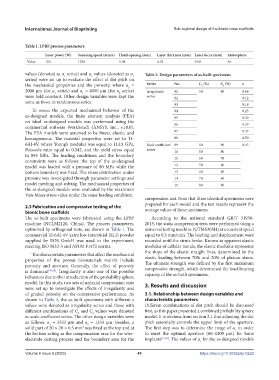
            values (denoted as a  series) and a  values (denoted as a    Table 2. Design parameters of as-built specimens
                                        2
                            1
                                                          2
            series) were set up to evaluate the effect of dot pitch on
            the  mechanical  properties and  the  porosity,  where  a  =   Series  No.  C  (%)  C  (%)  ε
                                                                                                2
                                                                                       1
                                                        2
            2000 μm (for a  series) and a  = 4000 μm (for a  series)   Irregularity   01  50   90       0.06
                                    1
                                                    2
                        1
            were held constant. Other design variables were kept the   series  02                       0.12
            same as those in randomness series.
                                                                           03                           0.18
               To  assess  the  expected  mechanical  behavior  of  the    04                           0.25
            as-designed models, the finite element analysis (FEA)          05                           0.30
            on ideal as-designed models was performed using the            06                           0.39
            commercial  software  Workbench  (ANSYS,  Inc.,  v.18.0).
            The FEA models were assumed to be linear, elastic, and         07                           0.47
            homogeneous.  The  material  properties  were  set  to  Ti-    08                           0.50
            6Al-4V, where Young’s modulus was equal to 113.8 GPa,   Scale  coefficient  09  50  90      0.47
            Poisson’s ratio equal to 0.342, and the yield stress equal   series  10   50       80
            to 895 MPa. The loading conditions and the boundary            11         50       70
            constraints were as follows: the top of the as-designed
            model was loaded with a pressure of 80 MPa while the           12         50       60
            bottom boundary was fixed. The stress distribution under       13         60       90
            pressure was investigated through parameter settings and       14         70       90
            model meshing and solving. The mechanical properties of        15         80       90
            the as-designed models were evaluated by the maximum
            Von-Mises stress value under the same loading condition.
                                                               compression test. Note that three identical specimens were
                                                               prepared for each model and the test results represent the
            2.3 Fabrication and compressive testing of the     average values of these specimens.
            bionic bone scaffolds
            The as-built specimens were fabricated using the LPBF   According to the national standard GB/T 31930-
            machine (NCLM2120, China). The process parameters,   2015, the static compression tests were performed using a
            optimized by orthogonal tests, are shown in Table 1. The   universal testing machine (UTM5305H) at a constant speed
            commercial Ti-6Al-4V extra low interstitial (ELI) powder   equal to 0.5 mm/min. The loading and displacement were
            supplied by EOS GmbH was used in the experiment,   recorded until the struts broke. Known as apparent elastic
            meeting ISO 5832-3 and ASTM F1472 norms.           modulus of cellular metals, the elastic modulus represents
                                                               the slope of the elastic straight lines, determined by the
               The characteristic parameters that affect the mechanical
            properties of the porous biomaterials mainly include   elastic loading between 70% and 20% of plateau stress.
                                                               The ultimate strength was defined by the first maximum
            porosity and aperture. Generally, the effect of porosity   compressive strength, which determined the load-bearing
            is dominant [39,40] . Irregularity is also one of the possible   capacity of the as-built specimens.
            influences due to the introduction of the probability sphere
            model. In this study, two sets of uniaxial compression tests   3. Results and discussion
            were set up to investigate the effects of irregularity and
            of graded porosity on the compressive performance. As   3.1. Relationship between design variables and
            shown in Table 2, the as-built specimens with different ε   characteristic parameters
            values were denoted as irregularity series and those with   Different combinations of dot pitch should be discussed
            different combinations of C  and C  values were denoted   first, as this paper presented a combined probability sphere
                                        2
                                  1
            as scale coefficient series. The other design variables were   model. It is obvious from section 2.1 that adjusting the dot
            as follows:  a  = 3333 μm and  a  = 1333 μm. Besides, a   pitch essentially controls the upper limit of the aperture.
                                      2
                      1
            solid part of 20 × 20 × 0.5 mm  was fixed at the top and at   The first step was to determine the range of a  in order
                                    3
                                                                                                     1
            the bottom acting as the compensation area for the wire-  to meet the optimal aperture (60–1200 μm) for bone
            electrode cutting process and the boundary area for the   implants [11,41] . The values of a  for the as-designed models
                                                                                      1
            Volume 9 Issue 6 (2023)                         45                        https://doi.org/10.36922/ijb.0222

