


Page 57 - IJB-9-6
P. 57
International Journal of Bioprinting                           Sub-regional design of the bionic bone scaffolds


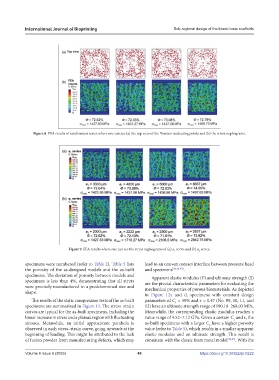
               Figure 8. FEA results of randomness series where one can see (a) the top view of the Voronoi nucleating points and (b) the stress nephograms.


                              Figure 9. FEA results where one can see the stress nephograms of (a) a  series and (b) a  series.
                                                                           1          2
            specimens were numbered (refer to Table 2). Table 5 lists   lead to an uneven contact interface between pressure head
            the porosity of the as-designed models and the as-built   and specimens [36,42,43] .
            specimens. The deviation of porosity between models and   Apparent elastic modulus (E) and ultimate strength (S)
            specimens is less than 4%, demonstrating that all struts   are the pivotal characteristic parameters for evaluating the
            were precisely manufactured to a predetermined size and   mechanical properties of porous biomaterials. As depicted
            shape.
                                                               in  Figure 12a and d, specimens with constant design
               The results of the static compression tests of the as-built   parameters of C  = 50% and ε = 0.47 (No. 09, 10, 11, and
                                                                            1
            specimens are summarized in Figure 11. The stress–strain   12) have an ultimate strength range of 190.19–268.03 MPa.
            curves are typical for the as-built specimens, including the   Meanwhile, the corresponding elastic modulus reaches a
            linear increase in stress and a plateau region with fluctuating   value range of 4.52–7.12 GPa. Given a certain C  and ε, the
                                                                                                     1
            stresses. Meanwhile, an initial approximate parabola is   as-built specimens with a larger C  have a higher porosity
                                                                                          2
            observed in each stress–strain curve, going upwards at the   value (refer to Table 5), which results in a smaller apparent
            beginning of loading. This might be attributed to the lack   elastic  modulus and  an  ultimate  strength.  This  result  is
            of fusion powder from manufacturing defects, which may   consistent with the classic foam metal model [44,45] . With the

            Volume 9 Issue 6 (2023)                         49                        https://doi.org/10.36922/ijb.0222

