


Page 91 - IJOCTA-15-4
P. 91
Advanced frequency control strategy for power systems with high renewable energy penetration
            in which f ofs,max and f ofs,min are the maxi-    control after abnormal voltage fluctuations oc-
            mum and minimum offset frequencies, respec-       cur. The amount of reactive power injected or
            tively. SOC tot is the SOC control range, and K r  absorbed by the BESS device in response to a
            is the primary droop gain and can be expressed    given voltage change must comply with grid code
            as follows in Equation (17):                      requirements. The reference reactive power con-
                                                              trol signal is generated based on the voltage er-
                                                              ror between the voltage at PCC and the refer-


                                                              ence voltage, following the droop control method.

                                    1

                 K r = K A K f ∆f ·  − P ref ·  1          In this study, the droop control method was ap-

                                   K f                 (17)
                                             K E s          plied from the perspective of the Australian En-
                                        |   {z   }
                             | {z }
                                          ∆SOC
                              ∆SOC ref                        ergy Market Operator (AEMO), and the droop
                                                              characteristic of voltage variation corresponding
                    = |∆f − f of (s)| K A
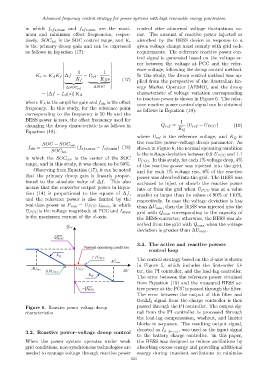
                                                              to reactive power is shown in Figure 6. The refer-
            where K A is the amplifier gain and f ofs is the offset  ence reactive power control signal can be obtained
            frequency. In this study, for the reference point  as follows in Equation (19):
            corresponding to the frequency is 50 Hz and the
            BESS power is zero, the offset frequency used for                    1
            changing the droop characteristic is as follows in           Q ref =    (U ref − U PCC )     (19)
                                                                                K Q
            Equation (18).
                                                              where U ref is the reference voltage, and K Q is
                                                              the reactive power–voltage droop parameter. As
                    SOC − SOC cen
             f ofs =               (f ofs,max − f ofs,min ) (18)  shown in Figure 6, the normal operating condition
                        SOC tot
                                                              is the voltage deviation between 0.9 U PCC and 1.1
            in which the SOC cen is the center of the SOC
                                                              U PCC . In this study, for each 1% voltage drop, 4%
            range, and in this study, it was chosen to be 50%.
                                                              of the reactive power was injected into the grid,
                Observing from Equation (17), it can be noted  and for each 1% voltage rise, 6% of the reactive
            that the primary droop gain is linearly propor-   power was absorbed into the grid. The BESS was
            tional to the absolute value of ∆f.   This also   activated to inject or absorb the reactive power
            means that the converter output power in Equa-    into or from the grid when U PCC was at a value
            tion (14) is proportional to the square of ∆f,
                                                              smaller or larger than its values of 90% or 110%,
            and the reference power is also limited by the
                                                              respectively. In case the voltage deviation is less
            real-time power as P max = U PCC I dmax , in which
                                                              than ∆U min , then the BESS was injected into the
                                                              grid with Q max corresponding to the capacity of
            U PCC is the voltage magnitude at PCC and I dmax
            is the maximum current of the d-axis.             the BESS-converter; otherwise, the BESS was ab-
                                                              sorbed from the grid with Q max when the voltage
                                                              deviation is greater than ∆U max .
                                                              3.3. The active and reactive powers
                                                                   control loop
                                                              The control strategy based on the d-axis is shown
                                                              in Figure 5, which includes the first-order fil-
                                                              ter, the PI controller, and the lead-lag controller.
                                                              The error between the reference power obtained
                                                              from Equation (15) and the measured BESS ac-
                                                              tive power at the PCC is passed through the filter.
                                                              The error between the output of this filter and
                                                              the∆I d signal from the charge controller is then
            Figure 6. Reactive power–voltage droop            passed through the PI controller. The output sig-
            characteristics                                   nal from the PI controller is processed through
                                                              the lead-lag compensation, washout, and limiter
                                                              blocks in sequence. The resulting output signal,
                                                                                , was used as the input signal
                                                              denoted as I d −p −ref
            3.2. Reactive power–voltage droop control
                                                              to the battery charge controller. In this paper,
            When the power system operates under weak         the BESS was designed to reduce oscillations by
            grid conditions, non-synchronous technologies are  absorbing excess energy and providing additional
            needed to manage voltage through reactive power   energy during transient oscillations to minimize
                                                           633

