


Page 92 - IJOCTA-15-4
P. 92
Viet Thanh et al. / IJOCTA, Vol.15, No.4, pp.625-648 (2025)
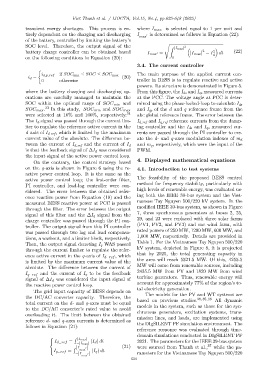
transient energy shortages. This process is en- where I max is selected equal to 1 per unit and
tirely dependent on the charging and discharging I ′ is determined as follows in Equation (22):
max
of the battery, controlled by limiting the battery’s
SOC level. Therefore, the output signal of the s Z 2
|I max|
2
battery charge controller can be obtained based I max’ = |I max | − I d 2 dt (22)
on the following conditions in Equation (20): 0
3.4. The current controller
(
i d p ref if SOC min ≤ SOC ≤ SOC max The main purpose of the applied current con-
i d = (20)
0 otherwise troller in BESS is to regulate reactive and active
powers. Its structure is demonstrated in Figure 5.
where the battery charging and discharging op- From this figure, the I ds and I qs measured currents
erations are carefully managed to maintain the at the PCC. The voltage angle at PCC is deter-
SOC within the optimal range of SOC min and mined using the phase-locked-loop to calculate I ds
SOC max . 33 In this study, SOC min and SOC max and I qs of the d and q reference frame from the
were selected at 10% and 100%, respectively. 34 abc global reference frame. The error between the
The I d signal was passed through the current lim- I d ref and I q ref reference currents from the damp-
iter to regulate the reference active current in the ing controller and the I ds and I qs measured cur-
d axis of I d ref , which is limited by the maximum rents are passed through the PI controller to cre-
current value of the absolute. The difference be- ate the d- and q-axes modulation indexes of m d
tween the current of I d ref and the current of I d and m q , respectively, which were the input of the
is that the feedback signal of ∆I d was considered PWM.
the input signal of the active power control loop.
4. Displayed mathematical equations
On the contrary, the control strategy based
on the q-axis is shown in Figure 6 using the re- 4.1. Introduction to test systems
active power control loop. It is the same as the
active power control loop; the first-order filter, The feasibility of the proposed BESS control
PI controller, and lead-lag controller were con- method for frequency stability, particularly with
sidered. The error between the obtained refer- high levels of renewable energy, was evaluated us-
ing both the IEEE 39-bus system and the Viet-
ence reactive power from Equation (19) and the
namese Tay Nguyen 500/220 kV system. In the
measured BESS reactive power at PCC is passed
modified IEEE 39-bus system, as shown in Figure
through the filter. The error between the output
7, three synchronous generators at buses 2, 25,
signal of this filter and the ∆I q signal from the
29, and 23 were replaced with three solar farms
charge controller was passed through the PI con-
(PV1, PV2, and PV3) and one wind farm, with
troller. The output signal from this PI controller
rated powers of 250 MW, 1200 MW, 600 MW, and
was passed through two lag and lead compensa-
1,000 MW, respectively. Details are provided in
tions, a washout, and a limiter block, respectively.
Table 1. For the Vietnamese Tay Nguyen 500/220
Then, the output signal denoting I q WAS passed
kV system, depicted in Figure 8, it is projected
through the current limiter to regulate the refer-
that by 2025, the total generating capacity in
ence active current in the q-axis of I d −ref , which
the area will reach 5521.5 MW. Of this, 4255.5
is limited by the maximum current value of the
MW will come from renewable sources, including
absolute. The difference between the current of
2435.5 MW from PV and 1820 MW from wind
I q −ref and the current of I q to be the feedback
turbine generators. Thus, renewable energy will
signal of ∆I d was considered the input signal of
the reactive power control loop. account for approximately 77% of the region’s to-
tal electricity generation.
The grid input capacity of BESS depends on
the DC/AC converter capacity. Therefore, the The models for the PV and WT systems are
26,35,36
total current on the d- and q-axes must be equal based on previous studies. All dynamic
to the DC/AC converter’s rated value to avoid models in the system, such as those for the syn-
overloading it. The limit between the obtained chronous generators, excitation systems, trans-
mission lines, and loads, are implemented using
reference d- and q-axes currents is determined as
the DIgSILENT PF simulation environment. The
follows in Equation (21):
reference response was evaluated through time-
domain simulations conducted in DIgSILENT PF
R |I max|
I d −ref = (I d ) dt 2021. The parameters for the IEEE 39-bus system
−|I max|
R |I ′| (21) were sourced from Thanh et al., 37 while the pa-
I q −ref = max (I q ) dt
−|I ′| rameters for the Vietnamese Tay Nguyen 500/220
max
634

