


Page 97 - IJOCTA-15-4
P. 97
Advanced frequency control strategy for power systems with high renewable energy penetration


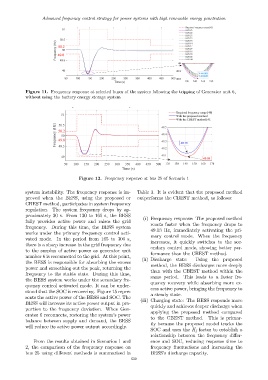
            Figure 11. Frequency response at selected buses of the system following the tripping of Generator unit 6,
            without using the battery energy storage system


                                    Figure 12. Frequency response at bus 25 of Scenario 1


            system instability. The frequency response is im-  Table 3. It is evident that the proposed method
            proved when the BESS, using the proposed or       outperforms the CBEST method, as follows:
            CBEST method, participates in system frequency
            regulation. The system frequency drops by ap-
            proximately 30 s. From 130 to 165 s, the BESS
                                                                 (i) Frequency response: The proposed method
            fully provides active power and raises the grid
                                                                    reacts faster when the frequency drops to
            frequency. During this time, the BESS system
                                                                    49.13 Hz, immediately activating the pri-
            works under the primary frequency control acti-
                                                                    mary control mode. When the frequency
            vated mode. In the period from 165 to 300 s,
                                                                    increases, it quickly switches to the sec-
            there is a sharp increase in the grid frequency due
                                                                    ondary control mode, showing better per-
            to the surplus of active power as generator unit
                                                                    formance than the CBEST method.
            number 6 is reconnected to the grid. At this point,
                                                                (ii) Discharge state:   Using the proposed
            the BESS is responsible for absorbing the excess
                                                                    method, the BESS discharges more deeply
            power and smoothing out the peak, returning the
                                                                    than with the CBEST method within the
            frequency to the stable state. During this time,
                                                                    same period. This leads to a faster fre-
            the BESS system works under the secondary fre-
                                                                    quency recovery while absorbing more ex-
            quency control activated mode. It can be under-         cess active power, bringing the frequency to
            stood that the SOC is recovering. Figure 15 repre-
            sents the active power of the BESS and SOC. The         a steady state.
            BESS will increase its active power output in pro-  (iii) Charging state: The BESS responds more
            portion to the frequency deviation. When Gen-           quickly and achieves deeper discharge when
            erator 6 reconnects, restoring the system’s power       applying the proposed method compared
                                                                    to the CBEST method. This is primar-
            balance between supply and demand, the BESS
                                                                    ily because the proposed model tracks the
            will reduce its active power output accordingly.
                                                                    SOC and uses the K f factor to establish a
                                                                    relationship between the frequency differ-
                From the results obtained in Scenarios 1 and        ence and SOC, reducing response time to
            2, the comparison of the frequency response on          frequency fluctuations and increasing the
            bus 25 using different methods is summarized in         BESS’s discharge capacity.
                                                           639

