


Page 98 - IJOCTA-15-4
P. 98
Viet Thanh et al. / IJOCTA, Vol.15, No.4, pp.625-648 (2025)


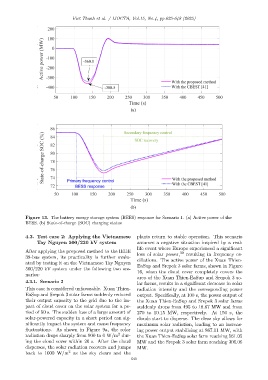
            Figure 13. The battery energy storage system (BEES) response for Scenario 1. (a) Active power of the
            BESS. (b) State-of-charge (SOC) charging status


            4.3. Test case 2: Applying the Vietnamese         plants return to stable operation. This scenario
                 Tay Nguyen 500/220 kV system                 assumes a negative situation inspired by a real-
                                                              life event where Europe experienced a significant
            After applying the proposed method to the IEEE                       39
                                                              loss of solar power,  resulting in frequency os-
            39-bus system, its practicality is further evalu-
                                                              cillations. The active power of the Xuan Thien-
            ated by testing it on the Vietnamese Tay Nguyen
                                                              EaSup and Srepok 3 solar farms, shown in Figure
            500/220 kV system under the following two sce-
                                                              16, when the cloud cover completely covers the
            narios:
                                                              area of the Xuan Thien-EaSup and Srepok 3 so-
            4.3.1. Scenario 3
                                                              lar farms, results in a significant decrease in solar
            This case is considered unfavorable. Xuan Thien-  radiation intensity and the corresponding power
            EaSup and Srepok 3 solar farms suddenly reduced   output. Specifically, at 100 s, the power output of
            their output capacity to the grid due to the im-  the Xuan Thien-EaSup and Srepok 3 solar farms
            pact of cloud cover on the solar system for a pe-  suddenly drops from 495 to 18.67 MW and from
            riod of 50 s. The sudden loss of a large amount of  270 to 10.15 MW, respectively. At 150 s, the
            solar-powered capacity in a short period can sig-  clouds start to disperse. The clear sky allows for
            nificantly impact the system and cause frequency  maximum solar radiation, leading to an increas-
            fluctuations. As shown in Figure 9a, the solar    ing power output stabilizing at 867.11 MW, with
                                                      2
            radiation drops sharply from 900 to 0 W/m dur-    the Xuan Thien-EaSup solar farm reaching 561.05
            ing the cloud cover within 20 s. After the cloud  MW and the Srepok 3 solar farm reaching 306.06
            disperses, the solar radiation recovers and jumps  MW.
                               2
            back to 1000 W/m as the sky clears and the
                                                           640

