


Page 44 - JCBP-2-3
P. 44
Journal of Clinical and
            Basic Psychosomatics                                                     Emotions in anophthalmic patients


            Table 2. Optimal scale regression statistical analysis results   Table 2. (Continued)
            of PHQ‑9 scale
                                                                                     β   Quantification  F  P
                                  β   Quantification  F  P      2–5 years                      0.765
            Gender               0.078            1.860 0.177   >5 years                       0.765
             Male                        −0.961                Satisfaction of wearing   −0.504     26.375 0.001
             Female                        1.041               prosthetic eyes
            Age (years)         −0.107            1.694 0.191   Uncomfortable               −2.550
             16–25                       −1.435                 General comfortable            0.014
             26–55                          0.325               Very comfortable               1.046
             >55                            3.203
            Geographical area    0.122            2.600 0.111  of the population in China is right-eye dominant.  The
                                                                                                        19
            of residence                                       dominant eye plays a more crucial role in daily life, making
             Rural                          0.750              the blindness in the right eye the cause of more physical
             Urban                       −1.333                and psychological challenges.
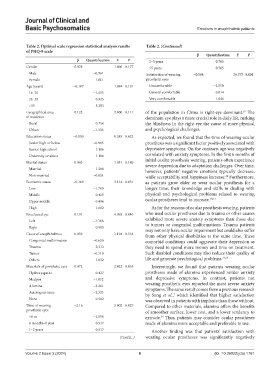
            Education status    −0.050            0.245 0.622    As expected, we found that the time of wearing ocular
             Junior high or below        −0.905                prosthesis was a significant factor positively associated with
             Senior high school             1.106              depressive symptoms. On the contrary, age was negatively
             University or above            1.106              correlated with anxiety symptoms. In the first 6 months of
            Marital status       0.083            1.831 0.180  initial ocular prosthesis wearing, patients often experience
                                                               severe depression due to adaptation challenges. Over time,
             Married                        1.200              however, patients’ negative emotions typically decrease,
             Non-married                 −0.834                while acceptability and happiness increase.  Furthermore,
                                                                                                 20
            Economic status     −0.169            3.114 0.031  as patients grow older  or wear ocular prosthesis for a
             Low                         −1.700                longer time, their knowledge and skills in dealing with
             Middle                         0.425              physical and psychological problems related to wearing
             Upper middle                   0.496              ocular prostheses tend to increase. 20,21
             High                           1.602                As for the reasons of ocular prosthesis wearing, patients
            Enucleated eye       0.131            4.093 0.046  who used ocular prostheses due to trauma or other causes
             Left                        −1.106                exhibited more severe anxiety symptoms than those due
             Right                          0.905              to tumors or congenital malformations. Trauma patients
                                                               may not only have ocular impairment but could also suffer
            Cause of anophthalmos  0.059          1.194 0.318  from other physical disabilities at the same time. These
             Congenital malformation     −0.630                comorbid conditions could aggravate their depression as
             Trauma                         2.313              they need to spend more money and time on treatment.
             Tumor                       −0.110                Such disabled conditions may also reduce their quality of
             Others                         1.032              life and generate psychological problems. 22,23
            Materials of prosthetic eyes  0.072   2.422 0.055    Interestingly, we  found that  patients wearing  ocular
             Hydroxyapatite                 0.427              prostheses made of alumina experienced milder anxiety
             Medpor                      −1.872                and depressive symptoms. In contrast, patients not
             Alumina                     −3.261                wearing prosthetic eyes reported the most severe anxiety
                                                               symptoms. The same result comes from a previous research
             Autologous issue            −2.333                by Song  et  al.,  which identified that higher satisfaction
                                                                           7
             None                           0.502              was observed in patients with implants than those without.
            Time of wearing      −2.16            3.802 0.027  Compared to other materials, alumina offers the benefits
            prosthetic eyes                                    of smoother surface, lower cost, and a lower tendency to
             <6 m                        −1.556                extrude.  Thus, patients may consider ocular prostheses
                                                                     24
             6 months–1 year                0.517              made of alumina more acceptable and preferable to use.
             1–2 years                      0.517                Another finding was that patients’ satisfaction with
                                                    (Cont’d...)  wearing ocular prostheses was significantly negatively


            Volume 2 Issue 3 (2024)                         6                               doi: 10.36922/jcbp.1761

