


Page 45 - JCBP-2-3
P. 45
Journal of Clinical and
            Basic Psychosomatics                                                     Emotions in anophthalmic patients


            Table 3. Optimal scale regression statistical analysis results   Table 3. (Continued)
            of GAD‑7 scale
                                                                                     Β   Quantification  F  P
                                  Β   Quantification  F  P      1–2 years                   −0.369
            Gender               0.079            1.790 0.185   2–5 years                   −0.369
             Male                        −0.961                 >5 years                       2.708
             Female                         1.041              Satisfaction of wearing   −0.540     26.083 0.001
            Age (years)          −0.311           8.619 0.001  prosthetic eyes
             16–25                       −1.565                 Uncomfortable               −2.119
             26–55                          0.404               General comfortable         −0.192
                                            0.423               Very comfortable               1.363
                                            0.423
                                            2.448
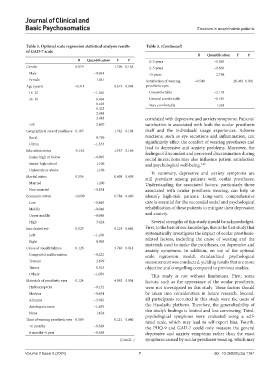
                                            2.448              correlated with depressive and anxiety symptoms. Patients’
             >55                            2.607              satisfaction is associated with both the ocular prosthesis
            Geographical area of residence 0.107  1.742 0.191  itself and the individuals’ usage experiences. Adverse
             Rural                          0.750              reactions, such as eye secretions and inflammation, can
             Urban                       −1.333                significantly affect the comfort of wearing prostheses and
            Education status     -0.162           1.957 0.166  lead to depressive and anxiety problems. Moreover, the
                                                               feelings of discomfort and perceived discrimination during
             Junior high or below        −0.905                social interactions may also influence patient satisfaction
             Senior high school             1.106              and psychological well-being. 7,25
             University or above            1.106                In summary, depressive and anxiety symptoms are
            Marital status       0.056            0.608 0.438
                                                               still prevalent among patients with ocular prostheses.
             Married                        1.200              Understanding the associated factors, particularly those
             Non-married                 −0.834                associated  with  ocular  prosthesis  wearing,  can  help  us
            Economic status      −0.099           0.784 0.460  identify high-risk patients. Long-term comprehensive
             Low                         −0.860                care is essential for the successful social and psychological
             Middle                      −0.048                rehabilitation of these patients to mitigate their depression
             Upper middle                −0.048                and anxiety.
             High                           3.424                Several strengths of this study should be acknowledged.
            Enucleated eye       0.023            0.218 0.642  First, to the best of our knowledge, this is the first study that
             Left                        −1.106                systematically investigates the impact of ocular prosthesis-
             Right                          0.905              related factors, including the cause of wearing and the
                                                               materials used to make the prostheses, on depressive and
            Cause of anophthalmos  0.128          3.740 0.014  anxiety symptoms. In addition, on top of the optimal
             Congenital malformation     −0.222                scale regression model, standardized psychological
             Trauma                         2.699              measurement was conducted, yielding results that are more
             Tumor                          0.015              objective and compelling compared to previous studies.
             Others                      −1.056                  This study is not without limitations. First, some
            Materials of prosthetic eyes  0.124   4.963 0.001  factors, such as the appearance of the ocular prosthesis,
             Hydroxyapatite              −0.132                were not investigated in this study. These factors should
             Medpor                      −0.634                be taken into consideration in future research. Second,
             Alumina                     −3.965                all participants recruited in this study were the users of
             Autologous issue            −1.630                the Haodaifu platform. Therefore, the generalizability of
             None                           1.624              this study’s findings is limited and less convincing. Third,
            Time of wearing prosthetic eyes 0.080  0.221 0.640  psychological symptoms were evaluated using a self-
                                                               rated scale, which may lead to self-report bias. Fourth,
             <6 months                   −0.369                the  PHQ-9  and  GAD-7  could  only  measure  the  general
             6 months–1 year             −0.369                depressive and anxiety symptoms rather than the exact
                                                    (Cont’d...)  symptoms caused by ocular prosthesis wearing, which may

            Volume 2 Issue 3 (2024)                         7                               doi: 10.36922/jcbp.1761

