


Page 97 - MSAM-4-1
P. 97
Materials Science in Additive Manufacturing                  Additive manufacturing of NASA HR-1 angled walls


            among the samples. All samples printed at 1,070 W,   the opposite edge of the sample until complete rupture
            regardless of their angles (0°, 20°, and 30°), showed no   occurred. This behavior can be attributed to sharp corners
            statistical differences, as P-values were greater than 0.05   acting as stress concentrators, which promote fatigue crack
            during testing. Furthermore, t-tests indicated no significant   initiation. 32,33
            difference between the 1,070 W and 2,620 W samples.
            This similarity in fatigue behavior can be attributed to   4. Conclusion
            the comparable grain size and  γ’ distribution across the   In this study, LP-DED NASA HR1 angled walls were
            samples, as these features can impede the propagation of   manufactured using two different parameter sets, 1,070 W
            fatigue cracks. 27,31                              and 2,620 W, and three deposition angles: 0°, 20°, and 30°.

              One sample from each build angle and laser power   The samples underwent a comprehensive heat treatment
            setting was selected for observation under an SEM to   process comprising stress relief, homogenization, solution
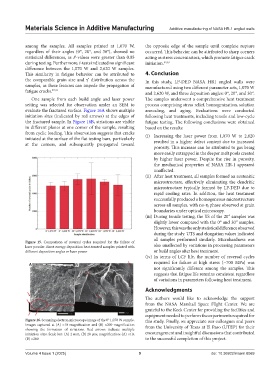
            evaluate the fractured surface. Figure 16A shows multiple   annealing,  and  aging.  Evaluations  were  conducted
            initiation sites (indicated by red arrows) at the edges of   following heat treatments, including tensile and low-cycle
            the fractured sample. In Figure 16B, striations are visible   fatigue testing. The following conclusions were obtained
            in different planes at one corner of the sample, resulting   based on the results:
            from cyclic loading. This observation suggests that cracks   (i)  Increasing the laser power from 1,070 W to 2,620
            initiated at the surface of the flat testing bars, particularly   resulted in a higher defect content due to increased
            at the corners, and subsequently propagated toward
                                                                  porosity. This increase can be attributed to gas being
                                                                  more easily entrapped in the deeper melt pools created
                                                                  by higher laser power. Despite the rise in porosity,
                                                                  the mechanical properties of NASA HR-1 appeared
                                                                  unaffected.
                                                               (ii)  After heat treatment, all samples formed an austenitic
                                                                  microstructure, effectively eliminating the dendritic
                                                                  microstructure typically formed by LP-DED due to
                                                                  rapid cooling rates. In addition, the heat treatment
                                                                  successfully produced a homogeneous microstructure
                                                                  across all samples, with no-η phase observed at grain
                                                                  boundaries under optical microscopy.
                                                               (iii) During tensile testing, the YS of the 20° samples was
                                                                  slightly lower compared with the 0° and 30° samples.
                                                                  However, this was the only statistical difference observed
                                                                  during the study. UTS and elongation values indicated
                                                                  all  samples  performed  similarly.  Microhardness  was
            Figure  15. Comparison of reversal cycles required for the failure of
            laser powder direct energy deposition heat-treated samples printed with   also unaffected by variations in processing parameters
            different deposition angles or laser power            or build angles after heat treatment.
                                                               (iv)  In terms of LCF life, the number of reversal cycles
                                                                  required for failure at high stress (~700 MPa) was
             A                   B
                                                                  not significantly different among the samples. This
                                                                  suggests that fatigue life remains consistent regardless
                                                                  of variations in parameters following heat treatment.
                                                               Acknowledgments
                                                               The  authors  would  like  to  acknowledge  the  support
                                                               from  the NASA Marshall Space Flight Center. We are
                                                               grateful to the Keck Center for providing the facilities and
                                                               equipment needed to perform the experiments required for
            Figure 16. Scanning electron microscope image of the 0° 1,070 W sample.   this study. Finally, we appreciate our colleagues and peers
            Images captured at (A) ×10 magnification and (B) ×200 magnification   from the University of Texas at El Paso (UTEP) for their
            showing  the  formation  of striations.  Red  arrows  indicate  multiple
            initiation sites. Scale bar: (A) 2 mm, (B) 20 µm; magnification: (A) ×10,   encouragement and insightful discussions that contributed
            (B) ×200                                           to the successful completion of this project.


            Volume 4 Issue 1 (2025)                         9                              doi: 10.36922/msam.8069

