


Page 10 - OR-1-1
P. 10
biomedical research and applications. 13-15  3D bioprinting   the cultivation platform created by 3D bioprinting enhances
            involves printing bioink containing living cells to form   the versatility of organoid applications, including drug
            a 3D construct according to a preset structure.  The key   screening,  disease  research,  and  multiorgan  interaction
                                                   16
            elements of 3D bioprinting include the printing equipment,   studies. 27-29
            printing models, and bioink.  Printing devices are primarily   In this review, we explore recent advancements in the
                                   17
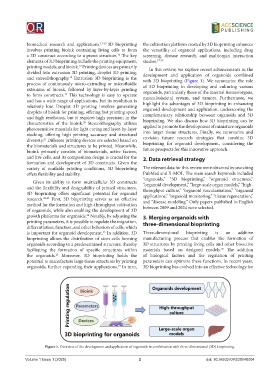
            divided into extrusion 3D printing, droplet 3D printing,   development and application of organoids combined
            and stereolithography.  Extrusion 3D bioprinting is the   with 3D bioprinting (Figure  1). We summarize the role
                               18
            process of continuously micro-extruding or microfluidic   of 3D bioprinting in developing and culturing various
            extrusion of bioink, followed by layer-by-layer printing   organoids, particularly those of the internal tissues/organs,
            to form constructs.  This technology is easy to operate   musculoskeletal system, and tumors. Furthermore, we
                            19
            and has a wide range of applications, but its resolution is   highlight the advantages of 3D bioprinting in enhancing
            relatively low. Droplet 3D printing involves generating   organoid development and application, underscoring the
            droplets of bioink for printing, offering fast printing speed
            and high resolution, but it requires high precision in the   complementary relationship between organoids and 3D
            characteristics of the bioink.  Stereolithography utilizes   bioprinting. We also discuss how 3D bioprinting can be
                                    20
            photosensitive materials for light curing and layer-by-layer   applied to promote the development of miniature organoids
            stacking, offering  high printing accuracy and  structural   into larger tissue structures. Finally, we summarize and
            diversity.  Different printing devices are selected based on   envision future research strategies that combine 3D
                    21
            the biomaterials and structures to be printed. Meanwhile,   bioprinting for organoid development, considering the
            bioink primarily consists of biomaterials, active factors,   future prospects for this innovative approach.
            and live cells, and its composition design is crucial for the   2. Data retrieval strategy
            formation and development of 3D constructs. Given the
            variety of available printing conditions, 3D bioprinting   The relevant data for this review were obtained by searching
            offers flexibility and stability.                 PubMed and X-MOL. The main search keywords included
                                                              “organoids,” “3D bioprinting,” “organoid structures,”
               Given its ability to form multicellular 3D constructs
            and the flexibility and designability of printed structures,   “organoid development,” “large-scale organ models,” “high-
                                                              throughput culture,” “organoid vascularisation,” “organoid
            3D bioprinting offers significant potential for organoid   applications,” “organoid monitoring,” “tissue regeneration,”
            research. 22,23  First, 3D bioprinting serves as an  effective   and “disease modeling.” Only papers published in English
            method for the formation and high-throughput cultivation   between 2009 and 2024 were selected.
            of organoids, while also enabling the development of 3D
            growth platforms for organoids.  Notably, by adjusting the   3. Merging organoids with
                                      24
            printing parameters, it is possible to regulate the migration,   three-dimensional bioprinting
            differentiation, function, and other behaviors of cells, which
            is important for organoid development.  In addition, 3D   Three-dimensional  bioprinting  is  an  additive
                                             25
            bioprinting allows the distribution of stem cells forming   manufacturing process that enables the formation of
            organoids according to a predetermined structure, thereby   3D structures by printing living cells and other bioactive
            facilitating the formation of specific structures within   materials  based  on  designed  models.   The  addition
                                                                                               18
            the organoids.  Moreover,  3D bioprinting holds the   of biological factors and the regulation of printing
                         26
            potential to manufacture large tissue structures by printing   parameters can optimize these functions. In recent years,
            organoids, further expanding their applications.  In turn,   3D bioprinting has evolved into an effective technology for
                                                   19


                    Figure 1. Overview of the development and application of organoids in combination with three-dimensional (3D) bioprinting.


            Volume 1 Issue 1 (2025)                         2                            doi: 10.36922/OR025040004

