


Page 158 - GPD-4-1
P. 158
Gene & Protein in Disease                                         FXR1 modulates gene expression in cancer


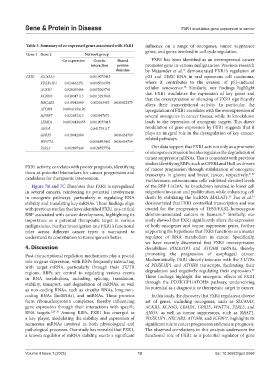
            Table 3. Summary of co‑expressed genes associated with FXR1  influence on a range of oncogenes, tumor suppressor
                                                               genes, and genes involved in cell cycle regulation.
            Gene 1 Gene 2            Network group
                            Co‑expression  Genetic   Shared      FXR1 has been identified as an overexpressed cancer
                                        interaction  protein   promoter gene in various malignancies. Previous research
                                                  domains      by  Majumder  et al.   demonstrated  FXR1’s  regulation  of
                                                                               12
            FXR1  SLC43A3              0.0019075415            p21 and  TERC RNA in oral squamous cell carcinoma,
                  PDZK1IP1   0.024462251  0.0005016976         where it contributes to the evasion of p53-induced
                                                                               12
                  ACKR3      0.020030404  0.0055209743         cellular senescence.  Similarly, our findings highlight
                  KCNN3      0.030047113  0.0013293843         that FXR1 modulates the expression of key genes and
                                                               that the overexpression or silencing of FXR1 significantly
                  NECAB2     0.019942889  0.002363983  0.008422975  alters their transcriptional activity. In particular, the
                  ATOH8     0.00041934196                      upregulation of FXR1 correlates with the overexpression of
                  IGFBP7     0.022652313  0.003947871          several oncogenes in cancer tissues, while its knockdown
                  LEMD1     0.00039458455  0.0019075415        leads to the repression of oncogenic targets. This direct
                  ANO5                  0.041739117            modulation of gene expression by FXR1 suggests that it
                  GPR35      0.019942889         0.006434719   plays an integral role in the dysregulation of key cancer-
                  WNT7A                0.0008893441 0.006434719  related pathways.
                  F2RL3      0.002897449  0.0024557738           Our data support that FXR1 acts not only as a promoter
                                                               of oncogene expression but also regulates the degradation of
                                                               tumor suppressor mRNAs. This is consistent with previous
                                                               studies identifying RBPs, such as CPEB4 and HuR, as drivers
            FXR1 activity, correlates with poorer prognosis, identifying   of cancer progression through stabilization of oncogenic
            them as potential biomarkers for cancer progression and   transcripts in glioma and breast cancer, respectively. 31,32
            candidates for therapeutic intervention.           Furthermore, osteosarcoma cells exhibited elevated levels

              Figure 7B and 7C illustrates that FXR1 is upregulated   of the RBP Lin28A; its knockdown resulted in lower cell
            in several cancers, reinforcing its potential involvement   migration/invasion and proliferation while enhancing cell
            in oncogenic pathways, particularly in regulating RNA   death  by stabilizing  the  lncRNA  MALAT1.   Fan  et al.
                                                                                                            34
                                                                                                  33
            stability and translating key mRNAs. These findings align   demonstrated that FXR1 controlled transcription and was
            with previous studies that have identified FXR1 as a critical   crucial for the progression of TP53/FXR2 homozygous
            RBP associated with cancer development, highlighting its   deletion-associated cancers in humans.  Similarly, our
                                                                                                34
            importance as a potential therapeutic target in various   study showed that FXR1 significantly alters the expression
            malignancies. Further investigation into FXR1’s functional   of both oncogenes and tumor suppressor genes, further
            roles across different cancer types is warranted to   supporting the hypothesis that FXR1 functions as a master
            understand its contribution to tumorigenesis better.  regulator of  RNA metabolism in  cancer. Specifically,
                                                               we have recently discovered that FXR1 overexpression
            4. Discussion                                      destabilizes  PDZK1IP1 and  ATOH8 mRNAs, thereby
            Post-transcriptional regulation mechanisms play a pivotal   promoting the progression of esophageal cancer.
            role in gene expression, with RBPs frequently interacting   Mechanistically, FXR1 directly interacts with the 3’UTRs
            with target mRNA, particularly through their 3’UTR   of  PDZK1IP1 and  ATOH8 transcripts, facilitating their
                                                                                                            35
            regions. RBPs are central to regulating various events   degradation and negatively regulating their expression.
            in  RNA  metabolism,  including  splicing,  translation,   These findings highlight the oncogenic  effects of FXR1
            stability,  transport,  and  degradation  of  mRNAs,  as  well   through the PDZK1IP1/ATOH8 pathway, underscoring
            as non-coding RNAs, such as circular RNAs, long non-  its potential as a diagnostic or therapeutic target in cancer.
            coding RNAs (lncRNAs), and miRNAs. These proteins    In this study, the discovery that FXR1 regulates a diverse
            form ribonucleoprotein complexes, thereby influencing   set of genes, including oncogenes, such as  SLC43A3,
            gene  expression through their  interactions with specific   ACKR3, KCNN3, LEMD1, GPR35, WNT7A,  F2RL3, and
            RNA targets. 5,27-30  Among RBPs, FXR1 has emerged as   ANO5,  as well as tumor suppressors, such as  NBAT1,
            a key player, modulating the stability and expression of   PDZK1IP1, NECAB2, ATOH8, and IGFBP7, highlights its
            numerous mRNAs involved in both physiological and   significant role in cancer progression and patient prognosis.
            pathological processes. Our study has revealed that FXR1,   The observed correlations in this analysis underscore the
            a known regulator of mRNA stability, exerts a significant   functional role of FXR1  as a potential regulator  of gene


            Volume 4 Issue 1 (2025)                         12                              doi: 10.36922/gpd.5068

