


Page 295 - IJB-10-1
P. 295
International Journal of Bioprinting                       Scaffolds manufacturing by fused deposition modeling


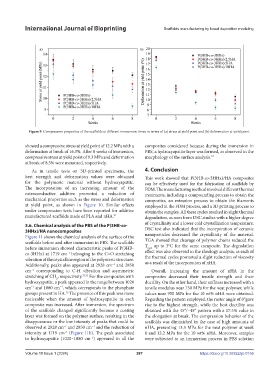
             Figure 9. Compression properties of the scaffolds at different immersion times in terms of (a) stress at yield point and (b) deformation at yield point.


            showed a compressive stress at yield point of 12.2 MPa with a   composites considered because during the immersion in
            deformation at break of 16.3%. After 8 weeks of immersion,   PBS, a hydroxyapatite layer was formed, as observed in the
            compressive stress at yield point of 9.3 MPa and deformation   morphology of the surface analysis. 94
            at break of 8.3% were measured, respectively.

               As in tensile tests on 3D-printed specimens, the   4. Conclusion
            best  strength and  deformation  values  were  obtained   This  work  showed  that  P(3HB-co-3HHx)/HA  composites
            for  the  polymeric  material  without  hydroxyapatite.   can be effectively used for the fabrication of scaffolds by
            The incorporation of an increasing amount of the   FDM. The manufacturing method involved different thermal
            osteoconductive additive promoted a reduction of   treatments, including a compounding process to obtain the
            mechanical properties such as the stress and deformation   composites, an extrusion process to obtain the filaments
            at  yield  point,  as  shown  in  Figure  10.  Similar  effects   employed in the FDM process, and a 3D printing process to
            under compression tests have been reported for additive   obtain the samples. All these cycles resulted in slight thermal
            manufactured scaffolds made of PLA and nHA. 91     degradation, as seen from DSC studies with a higher degree
            3.6. Chemical analysis of the PBS of the P(3HB-co-  of crystallinity and a lower cold crystallization temperature.
            3HHx)/HA nanocomposites                            DSC test also indicated that the incorporation of ceramic
            Figure 11 shows the chemical analysis of the surface of the   nanoparticles  decreased  the crystallinity of  the material.
            scaffolds before and after immersion in PBS. The scaffolds   TGA showed that cleavage of polymer chains reduced the
            before immersion showed characteristic peaks of P(3HB-  T  up  to 3°C for the  same composite. The degradation
                                                                max
            co-3HHx) at 1719 cm  belonging to the C=O stretching   effect was also observed in the rheology analysis, as each of
                              −1
            vibration of the crystalline region of the polymeric structure.   the thermal cycles promoted a slight reduction of viscosity
            Additionally, peaks also appeared at 2928 cm  and 2850   as a result of the incorporation of nHA.
                                                 −1
            cm  corresponding to C-H vibration and asymmetric     Overall, increasing the amount of nHA in the
              −1
            stretching of CH , respectively. 32,92  For the composites with   composites decreased their tensile strength and their
                         2
            hydroxyapatite, a peak appeared in the range between 1020   ductility. On the other hand, their stiffness increased with a
            cm  and 1080 cm , which corresponds to the phosphate   tensile modulus near 750 MPa for the neat polymer, while
              −1
                           −1
            groups present in HA.  The presence of this peak was more   values near 950 MPa for the 10 wt% nHA were obtained.
                             93
            noticeable when the amount of hydroxyapatite in each   Regarding the pattern employed, the raster angle of 0°gave
            composite was increased. After immersion, the spectrum   rise to the highest strength, while the best ductility was
            of  the  scaffolds  changed  significantly  because  a  coating   obtained with the 45°/–45° pattern with a 17.5% value in
            layer was formed on the polymer surface, resulting in the   the elongation at break. The compression behavior of the
            disappearance or the low intensity of peaks that could be   scaffolds was diminished in the case of high amounts of
            observed at 2928 cm  and 2850 cm  and the reduction of   nHA, presenting 13.5 MPa for the neat polymer at week
                                        −1
                            −1
            intensity at 1719 cm  (Figure 11b). The peak associated   0 and 12.2 MPa for the 10 wt% nHA. Moreover, samples
                             −1
            to hydroxyapatite (1020–1080 cm ) appeared in all the   were subjected to an immersion process in PBS solution
                                        −1
            Volume 10 Issue 1 (2024)                       287                        https://doi.org/10.36922/ijb.0156

