


Page 416 - IJB-10-1
P. 416
International Journal of Bioprinting                            Osteogenic differentiation of hMSCs by PBF-LB


            with a secondary antibody and Hoechst staining The   supernatant was removed, and 1 mL of PBS was added to
            aforementioned as well as subsequent manipulations were   the suspension. The cell concentration was adjusted to 2 ×
            performed  while  keeping  the  cells  away  from  light.  The   10  cells/mL in PBS. After that, the sample cell mixture for
                                                                 5
            cells were then washed thrice for 10 min each time in PBST   ICELL8 cx aliquot was prepared.
            and incubated in PBST containing phalloidin (Invitrogen,   The recovered cDNA was enriched using the  DNA
            Carlsbad, CA, USA). After that, the stained samples were   Clean & 5-kit (Zymo Research). To the cDNA product,
            mounted in ProLong™ Gold Antifade Mountant (Thermo   0.6× volume of AMPure XP beads was added, mixed by
            Fisher Scientific, Carlsbad, CA, USA).             pipetting, and incubated at room temperature for 5 min.
            2.5. Cell orientation analysis                     They were then placed on a magnetic stand and allowed
            Immunofluorescence  staining  was  performed  to   to stand for 2 min. The supernatant was removed with a
            quantitatively analyze the morphological changes in MSCs   pipette, and 200 µL of 70% ethanol was added to wash the
            on culture substrates. For each sample, images of F-actin,   beads and allowed to stand for 1 min. The tube was then
            vinculin, and nuclei were taken at multiple points with a   rotated and allowed to stand for 10 s on one side of the
            20× objective lens using a fluorescence microscope (BZ-  tube, and then reversed and allowed to stand again for 10
            X710, Keyence). Images were captured by focusing on cells   s on the other side. This procedure was repeated twice,
            adhering from the top of the groove shape. Single cells   and then the supernatant was removed with a pipette,
            were analyzed, excluding those whose cell morphology   and the procedure was repeated twice. Subsequently, the
            was difficult to accurately distinguish, and 40–60 stained   ethanol was removed with the tube still in place, the lid was
            cells were analyzed per sample. Images of the nuclei and   opened, and the beads were allowed to stand for less than
            F-actin/vinculin-stained images were gray scaled using   2 min to dry. Next, 13 µL of DNase-RNase-free water was
            Photoshop 6.0 (Adobe Inc., Mountain View, CA, USA)   added, mixed by pipetting, and incubated for 5 min. After
            and further binarized. Both images were loaded into   allowing it to stand for 1 min, 12 µL of the supernatant
            CellProfiler (Broad Institute Cambridge, MA, USA) to   was collected and transferred to a new tube. The resulting
            recognize the shape of the cell body based on the position   cDNA was quantified using the Qubit dsDNA HS Assay
            of the  cell nucleus. The cell shape  was approximated as   Kit (Life Technologies), and a Qubit 3.0 Fluorometer,
            an ellipse. The angle between the major axis of the ellipse   High Sensitivity DNA Kit, and Agilent 2100 Bioanalyzer
            and the groove direction on the substrate was defined as 0,    were used to confirm the quality of the cDNA libraries.
            and was represented in a histogram at 10° intervals. To   Library length was measured and quantified using a
            designate the flat substrate, is the angle between the major   High Sensitive DNA Kit and Agilent 2100 Bioanalyzer for
            axis of the ellipse and the scanning direction during   sequence  analysis.  The  library  was  sequenced  using  the
            modeling. The degree of cell orientation was defined as a   HiSeq2500 for Read1:26 cycles and Read2:101 cycles, and
            value representing the degree of cell orientation using the   approximately 250 million reads were obtained.
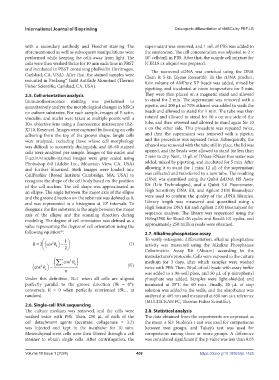
            following equation :                               2.7. Alkaline phosphatase assay
                           26
                            1                                To verify osteogenic differentiation, alkaline phosphatase
                       2
               R  2   cos                          (I)    activity was measured using the Alkaline Phosphatase
                        k   2                                Colorimetric Assay Kit (Abcam) according to the
                           1  n cos  k                     manufacturer’s protocols. Cells were exposed to the culture
                               2
                                                               medium for 3 days, after which samples were washed
                cos                                  (II)    twice with PBS. Then, 50 μL of cell lysate with assay buffer
                  2
                    k
                             n                                 was added to a 96-well plate, and 50 μL of p-nitrophenyl
            Under  this  definition,  R=1  when  all  cells  are  aligned   phosphate  was  added.  Samples  were  light-shielded and
            perfectly parallel to the groove direction (θk = 0°);   incubated at 25°C for 60 min. Finally, 20 µL of stop
            conversely, R = 0 when perfectly unoriented (θk… at   solution was added to the wells, and the absorbance was
            random).                                           analyzed at 405 nm and measured at 650 nm as a reference
                                                               (MULTICKAN FC, Thermo Fisher Scientific).
            2.6. Single-cell RNA sequencing
            The culture medium was removed, and the cells were   2.8. Statistical analysis
            washed  twice  with  PBS.  Then,  250  µL  of  each  of  the   The data obtained from the experiments are expressed as
            cell detachment agents (accutase: collagenase = 3:2)   the mean ± SD. Student’s t-test was used for comparisons
            was injected and kept in the incubator for 10 min.   between two groups, and Tukey’s test was used for
            Mesenchymal stem cells were then filtered through a cell   comparisons among three or more  groups. A difference
            strainer to obtain single cells. After centrifugation, the   was considered significant if the p-value was less than 0.05


            Volume 10 Issue 1 (2024)                       408                        https://doi.org/10.18063/ijb.1425

