


Page 417 - IJB-10-1
P. 417
International Journal of Bioprinting                           Osteogenic differentiation of hMSCs by PBF-LB


            for both tests. The sample sizes for cell analysis and single-  3.3. Gene expression analysis by single-cell
            cell RNA sequencing were 5 and 3, respectively.    RNA sequencing
                                                               Stemness properties of the cultured hMSCs were analyzed
            3. Results                                         by the comparison of  CD90,  CD44, and  SH2 expression
            3.1. Surface topography of the 3D-printed          analysis. The expression of CD90, a known stem cell marker
            Ti-6Al-4V surface                                  of MSC, was significantly decreased in MSCs cultured on
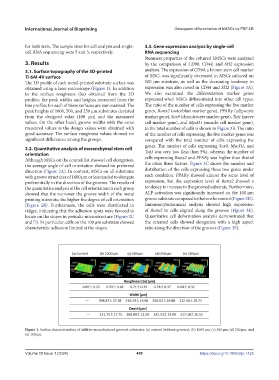
            The 3D profile of each metal-printed substrate surface was   100 µm substrate, as well as the decreasing tendency in
            obtained using a laser microscope (Figure 1). In addition   expression was also noted in CD44 and SH2 (Figure 3A).
            to the surface roughness (Sa) obtained from the 3D   We also examined the differentiation marker genes
            profiles, the peak widths and heights measured from the   expressed when MSCs differentiated into other cell types.
            line profiles for each of these surfaces are summarized. The   The ratio of the number of cells expressing the five marker
            peak heights of 1000, 500, and 250 µm substrates deviated   genes, Runx2 (osteoblast marker gene), PPARγ (adipocyte
            from the designed value (100 µm) and the measured   marker gene), Sox9 (chondrocyte marker gene), Tuj1 (nerve
            values. On the other hand, groove widths with the same   cell marker gene), and MyoD1 (muscle cell marker gene),
            measured values as the design values were obtained with   to the total number of cells is shown in Figure 3B. The ratio
            good accuracy. The surface roughness values showed no   of the number of cells expressing the five marker genes was
            significant differences among the groups.          compared with the total number of cells expressing the
                                                               genes. The number of cells expressing Sox9, MyoD1, and
            3.2. Quantitative analysis of mesenchymal stem cell
            orientation                                        Tuj1 was very low (less than 5%), whereas the number of
            Although MSCs on the control flat showed cell elongation,   cells expressing Runx2 and PPARγ was higher than that of
            the average angle of cell orientation showed no preferred   the other three factors. Figure 3C shows the number and
            direction (Figure 2A). In contrast, MSCs on all substrates   distribution of the cells expressing these two genes under
            with groove structures of 1000 µm or less tended to elongate   each condition.  PPARγ showed almost the same level of
            preferentially in the direction of the grooves. The results of   expression, but the expression level of  Runx2 showed a
            the quantitative analysis of the cell orientation in each group   tendency to increase in the grooved substrate. Furthermore,
            showed that the narrower the groove width of the metal   ALP activation was significantly increased on the 100 µm
            printing substrate, the higher the degree of cell orientation   groove substrate compared to that on the control (Figure 3D).
            (Figure 2B). Furthermore, the cells were distributed in   Immunocytochemical  analysis showed high expression
            ridges, indicating that the adhesion spots were favored to   of  Runx2 in cells aligned along the grooves (Figure 3E).
            locate on the slopes in periodic microstructure (Figure 2C   Quantitative cell deformation analysis demonstrated that
            and D). In particular, cells on the 100 µm substrate showed   the oriented cells showed elongation with a high aspect
            characteristic adhesion limited at the slopes.     ratio along the direction of the grooves (Figure 3F).


            Figure 1. Surface characterization of additive-manufactured grooved substrates: (a) control (without grooves), (b) 1000 μm, (c) 500 μm, (d) 250 μm, and
            (e) 100 μm.


            Volume 10 Issue 1 (2024)                       409                        https://doi.org/10.18063/ijb.1425

