


Page 21 - IJB-4-1
P. 21
Fan Liu, et al.

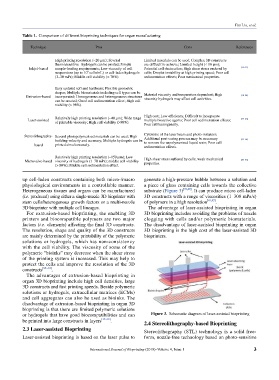
           Table 1.  Comparison of different bioprinting techniques for organ manufacturing

              Technique                   Pros                                  Cons                  References

                         High printing resolution (~20 µm); Several   Limited materials can be used; Complex 3D constructs
                         thermosensitive   hydrogels can be printed; Simple   are difficult to achieve; Limited  height (< 10 µm);
             Inkjet-based   sample-loading requirements; Low viscosity of cell   Potential cell desiccation; High shear stress endured by   [13–17]
                                      6
                         suspensions (up to 10  cells/mL) or cell-laden hydrogels   cells; Droplet instability at high printing speed; Poor cell
                         (3–30 mPs); Middle cell viability (> 70%).  sedimentation effects; Poor mechanical properties.
                         Easy updated soft and hardware; Flexible geometric
                         shapes; Multiple biomaterials including cell types can be   Material viscosity and temperature dependent; High
            Extrusion-based  incorporated; Homogeneous and heterogeneous structures   viscosity hydrogels may affect cell activities.   [18–24]
                         can be created; Good cell sedimentation effect; High cell
                         viability (> 98%).


                         Relatively high printing resolution (~40 µm); Wide range   High cost; Low efficiency; Difficult to incorporate   [39–42]
             Laser-assisted  of printable viscosity; High cell viability (>90%).  multiple bioactive agents; Poor cell sedimentation effects;
                                                               Poor cell homogeneity.

           Stereolithography- Several photopolymerized materials can be used; High   Cytotoxic of the laser beam and photo-initiators;
                         building velocity and accuracy; Multiple hydrogels can be   Additional post-curing process may be necessary   [43–46]
                based    printed simultaneously.               to remove the unpolymerized liquid resin; Poor cell
                                                               sedimentation effects.
                         Relatively high printing resolution (~150 µm); Low
            Microvalve-based viscosity of hydrogels (1–70 mPs); middle cell viability   High shear stress suffered by cells; weak mechanical   [50–53]
                                                               properties.
                         (> 80%); Middle cell sedimentation effect.

           up cell-laden constructs containing both micro-/macro   generate a high-pressure bubble between a solution and
           physiological environments in a controllable manner.   a piece of glass containing cells towards the collective
           Heterogeneous tissues and organs can be manufactured   substrate (Figure 3) [39,40] . It can produce micro cell-laden
           (i.e. produced) using either a single-nozzle 3D bioprinter with   3D constructs with a range of viscosities (1–300 mPa/s)
           stem cells/heterogenous growth factors or a multi-nozzle   of polymers in a high resolution [41,42] .
           3D bioprinter with multiple cell lineages.           The advantage of laser-assisted bioprinting in organ
            For extrusion-based bioprinting, the enabling 3D   3D bioprinting includes avoiding the problems of nozzle
           printers and biocompatible polymers are two major   clogging with cells and/or polymeric biomaterials.
           factors (i.e. elements) affecting the final 3D constructs.   The disadvantage of laser-assisted bioprinting in organ
           The resolution, shape and quality of the 3D constructs   3D bioprinting is the high cost of the laser-assisted 3D
           are mainly determined by the printability of the polymeric   bioprinters.
           solutions or hydrogels, which has non-consistency
           with the cell viability. The viscosity of some of the
           polymeric “bioinks” may decrease when the shear stress
           of the printing system is increased. This may help to
           protect the cells and improve the resolution of the 3D
           constructs [29–34] .
            The advantages of extrusion-based bioprinting in
           organ 3D bioprinting include high cell densities, large
           3D constructs and fast printing speeds. Beside polymeric
           solutions or hydrogels, extracellular matrices (ECMs)
           and cell aggregates can also be used as bioinks. The
           disadvantage of extrusion-based bioprinting in organ 3D
           bioprinting is that there are limited polymeric solutions
           or hydrogels that have good biocompatibilities and can   Figure 3.  Schematic diagram of laser-assisted bioprinting
           be printed into large constructs in layers [35–38] .     2.4 Stereolithography-based Bioprinting
           2.3 Laser-assisted Bioprinting                      Stereolithography (STL) technology is a solid free-

           Laser-assisted bioprinting is based on the laser pulse to   form, nozzle-free technology based on photo-sensitive

                                       International Journal of Bioprinting (2018)–Volume 4, Issue 1         3

