


Page 22 - IJB-4-1
P. 22
Progress in organ 3D bioprinting

           macromolecule (or polymer) formulation [43] . It is a   and the physiological functionality realization of a
           multi-layer procedure through the selective photo-  supportive polymeric solution or hydrogel often need to
           initiated curing reaction of a low-molecular weight pre-  be addressed before the 3D bioprinting process.
           polymer, additives and photo-initiators. Either a focused   3. Large Organ 3D Bioprinting
           ultraviolet beam light or a mask-based irradiation can
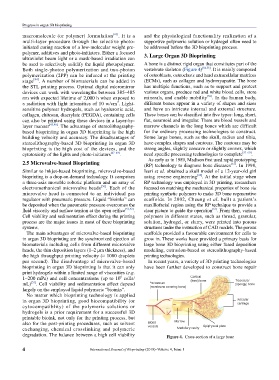
           be used to selectively solidify the liquid photopolymer.   A bone is a distinct rigid organ that constitutes part of the
           Both single-photon polymerization and two-photon    vertebrate skeleton (Figure 4) [54,55] . It is mainly composed
           polymerization (2PP) can be induced at the printing   of osteoblasts, osteoclasts and hard extracellular matrices
           stage [44] . A number of biomaterials can be added in   (ECMs), such as collagen and hydroxyapatite. The bone
           the STL printing process. Optimal digital micromirror   has multiple functions, such as to support and protect
           devices can work with wavelengths between 385–405   various organs, produce red and white blood cells, store
           nm with expected lifetime of 2,000 h when exposed to   minerals, and enable mobility [56] . In the human body,
                                                   2
           a radiation with light intensities of 10 w/cm . Light-  different bones appear in a variety of shapes and sizes
           sensitive polymer hydrogels, such as hyaluronic acid,   and have an intricate internal and external structure.
           collagen, chitosan, diacrylate (PEGDA), containing cells   These bones can be classified into five types: long, short,
           can also be printed using these devices in a layer-by-  flat, sesamoid and irregular. There are blood vessels and
           layer manner [45,46] . The advantage of stereolithography-  marrow channels in the long bones which are difficult
           based bioprinting in organ 3D bioprinting is the high   for the ordinary processing technologies to construct.
           building velocity and accuracy. The disadvantages of   Some large bones, such as the skull, radius and tibia,
           stereolithography-based 3D bioprinting in organ 3D   have complex shapes and contours. The contours may be
           bioprinting is the high cost of the devices, and the   strong angles, slightly concave or slightly convex, which
           cytotoxicity of the lights and photo-initiators [47–49] .  need specific processing technologies to complete [57–60] .
                                                                As early as in 1989, Madison first used rapid prototyping
           2.5 Microvalve-based Bioprinting                    (RP) technology to diagnose bone diseases [61] . In 1998,
           Similar to inkjet-based bioprinting, microvalve-based   Iseri et al. obtained a skull model of a 12-year-old girl
           bioprinting is a drop-on-demand technology. It comprises   using reverse engineering [62] . At the initial stage when
           a three-axis movable robotic platform and an array of   RP technology was employed in 3D printing, researchers
           electromethanical microvalve heads [50] . Each of the   focused on matching the mechanical properties of bone via
           microvalve head is connected to an individual gas   printing synthetic polymers to make 3D bone regenerative
           regulator with pneumatic pressure. Liquid “bioinks” can   scaffolds. In 2002, Cheung et al. built a patient’s
           be deposited when the pneumatic pressure overcomes the   maxillofacial region using the RP technique to provide a
                                                                                            [63]
           fluid viscosity and surface tension at the open orifice [51,52] .   clear picture to guide the operation . From then, various
           Cell viability and sedimentation effect during the printing   polymers in different states, such as thread, granular,
           process are the major issues in most of these bioprinting   solution, hydrogel, or slurry, were printed into porous
           systems.                                            structures under the instruction of CAD models. The porous
            The main advantages of microvalve-based bioprinting   scaffolds provided a favourable environment for cells to
           in organ 3D bioprinting are the synchronized ejection of   grow in. These works have provided a primary basis for
           biomaterials including cells from different microvalve   large bone 3D bioprinting using either fused deposition
           heads, the thin deposition layers (1–2 µm thickness), and   modeling, extrusion-based or stereolithography-based
           the high throughput printing velocity (≈ 1000 droplets   printing technologies.
           per second). The disadvantage of microvalve-based    In recent years, a variety of 3D printing technologies
           bioprinting in organ 3D bioprinting is that it can only   have been further developed to construct bone repair
           print hydrogels within a limited range of viscosities (e.g.
           1–200 mPa) and cell concentrations (up to 10  cells/
                                                    6
           mL) [53] . Cell viability and sedimentation effect depend
           largely on the employed liquid polymeric “bioinks”.
            No matter which bioprinting technology is applied
           in organ 3D bioprinting, good biocompatibility (or
           cytocompatiblity) of the polymeric solutions or
           hydrogels is a prior requirement for a successful 3D
           printable bioink, not only for the printing process, but
           also for the post-printing procedures, such as solvent
           exchanging, chemical crosslinking and polymeric
           degradation. The balance between a high cell viability       Figure 4.  Cross-section of a large bone


           4                           International Journal of Bioprinting (2018)–Volume 4, Issue 1

