


Page 68 - IJB-8-3
P. 68
Extrusion of two-vasculature scaffold for angiogenesis
                         A


                         B                                   C


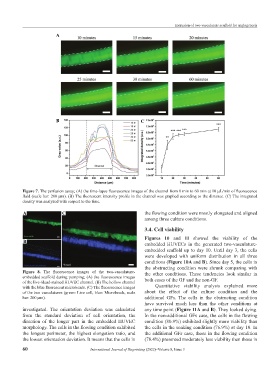
           Figure 7. The perfusion assay; (A) the time-lapse fluorescence images of the channel from 0 min to 60 min at 10 µL/min of fluorescence
           fluid (scale bar: 200 µm). (B) The fluorescent intensity profile in the channel was graphed according to the distance. (C) The integrated
           density was analyzed with respect to the time.

           A               C                                   the flowing condition were mostly elongated and aligned
                                                               among three culture conditions.

                                                               3.4. Cell viability
                                                               Figures  10 and  11  showed  the  viability  of  the
           B
                                                               embedded  HUVECs  in  the  generated  two-vasculature-
                                                               embedded scaffold up to day 10. Until day 3, the cells
                                                               were  developed  with  uniform  distribution  in  all  three
                                                               conditions (Figure 10A and B). Since day 5, the cells in
                                                               the  obstructing  condition  were  shrunk  comparing  with
           Figure  8.  The  fluorescence  images  of  the  two-vasculature-  the  other  conditions.  These  tendencies  look  similar  in
           embedded scaffold during pumping; (A) the fluorescence images
           of the live-/dead-stained HUVEC channel. (B) The hollow channel   both cases of the GF and the non-GF.
           with the blue fluorescent microbeads. (C) The fluorescence images   Quantitative  viability  analysis  explained  more
           of the two vasculatures (green: Live cell, blue: Microbeads, scale   about  the  effect  of  the  culture  condition  and  the
           bar: 200 µm).                                       additional  GFs.  The  cells  in  the  obstructing  condition
                                                               have  survived  much  less  than  the  other  conditions  at
           investigated.  The  orientation  deviation  was  calculated   any time point (Figure 11A and B). They looked dying.
           from  the  standard  deviation  of  cell  orientation,  the   In the non-additional GFs case, the cells in the flowing
           direction  of  the  longer  part  in  the  embedded  HUVEC   condition (80.9%) exhibited slightly more viability than
           morphology. The cells in the flowing condition exhibited   the cells in the soaking condition (76.9%) at day 10. In
           the  longest  perimeter,  the  highest  elongation  ratio,  and   the additional GFs case, those in the flowing condition
           the lowest orientation deviation. It means that the cells in   (78.4%) presented moderately less viability than those in

           60                          International Journal of Bioprinting (2022)–Volume 8, Issue 3

