


Page 32 - IMO-2-1
P. 32
Innovative Medicines & Omics                                                 Fermentation in dermatology


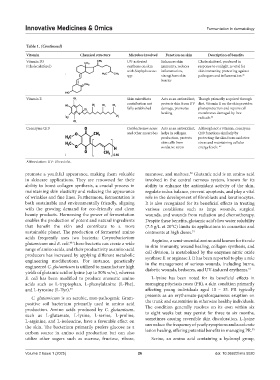
            Table 1. (Continued)
            Vitamin                Chemical structure   Microbes involved  Function on skin  Description of benefits
            Vitamin D3                                 UV-activated   Enhances skin   Cholecalciferol, produced in
            (Cholecalciferol)                          synthesis on skin   immunity, reduces   response to sunlight, is vital for
                                                       with Staphylococcus   inflammation,   skin immunity, protecting against
                                                       spp.           strengthens skin   pathogens and inflammation.
                                                                                                        45
                                                                      barrier


            Vitamin E                                  Skin microbiota   Acts as an antioxidant,  Though primarily acquired through
                                                       contribution not   protects skin from UV  diet, Vitamin E on the skin provides
                                                       fully established  damage, promotes   photoprotection and repairs cell
                                                                      healing        membranes damaged by free
                                                                                     radicals.
                                                                                           46
            Coenzyme Q10                               Cutibacterium acnes  Acts as an antioxidant,  Although not a vitamin, coenzyme
                                                       and other anaerobes helps in collagen   Q10 functions similarly by
                                                                      production, protects   protecting the skin from oxidative
                                                                      skin cells from   stress and maintaining cellular
                                                                      oxidative stress  energy levels.  47


            Abbreviation: UV: Ultraviolet.

            promote a youthful appearance, making them valuable   mannose, and maltose.  Glutamic acid is an amino acid
                                                                                  50
            in skincare applications. They are renowned for their   involved in the central nervous system, known for its
            ability  to boost  collagen synthesis, a  crucial  process in   ability to enhance the antioxidant activity of the skin,
            maintaining skin elasticity and reducing the appearance   regulate redox balance, prevent apoptosis, and play a vital
            of wrinkles and fine lines. Furthermore, fermentation is   role in the development of fibroblasts and keratinocytes.
            both sustainable and environmentally friendly, aligning   It is also recognized for its beneficial effects in treating
            with the growing demand for eco-friendly and clean   various conditions such as large wounds, surgical
            beauty products. Harnessing the power of fermentation   wounds, and wounds from radiation and chemotherapy.
            enables the production of potent and natural ingredients   Despite these benefits, glutamic acid’s low water solubility
            that benefit the skin and contribute to a more     (7.5 g/L at 20°C) limits its applications in cosmetics and
            sustainable planet. The production of fermented amino   ointments at high doses. 51
            acids frequently uses two bacteria:  Corynebacterium   Arginine, a semi-essential amino acid known for its role
            glutamicum and E. coli.  These bacteria can create a wide   in skin immunity, wound healing, collagen synthesis, and
                               48
            range of amino acids, and their productivity as amino acid   cell division, is metabolized by the enzymes nitric oxide
            producers has increased by applying different metabolic
            engineering modifications. For instance, genetically   synthase II or arginase I. It has been reported to play a role
                                                               in the management of serious wounds, including burns,
            engineered C. glutamicum is utilized to manufacture high   diabetic wounds, bedsores, and UV-induced erythema. 52
            yields of glutamic acid or lysine (up to 50% w/w), whereas
            E. coli has been modified to produce aromatic amino   L-lysine has been noted for its beneficial effects in
            acids such as L-tryptophan, L-phenylalanine (L-Phe),   managing pityriasis rosea (PR), a skin condition primarily
            and L-tyrosine (L-Tyr). 49                         affecting young individuals aged 10 – 35. PR typically
                                                               presents as an erythemato-papulosquamous eruption on
              C. glutamicum is an aerobic, non-pathogenic Gram-
            positive soil bacterium primarily used in amino acid   the trunk and extremities in otherwise healthy individuals.
            production. Amino  acids produced  by  C. glutamicum,   The condition generally resolves on its own within six
            such as L-glutamate, L-lysine, L-serine, L-proline,   to eight weeks but may persist for three to six months,
            L-arginine, and L-isoleucine, have a favorable effect on   sometimes  causing  reversible  skin  discoloration.  L-lysine
            the  skin. The  bacterium  primarily prefers  glucose  as a   can reduce the frequency of yearly symptoms and accelerate
                                                                                                            53
            carbon source in amino acid production but can also   lesion healing, offering potential benefits in managing PR.
            utilize  other  sugars  such  as  sucrose,  fructose,  ribose,   Serine, an amino acid containing a hydroxyl group,


            Volume 2 Issue 1 (2025)                         26                               doi: 10.36922/imo.5020

