


Page 88 - TD-3-3
P. 88
Tumor Discovery                                        PTMAP5–hsa-miR-22-3p–KIF2C axis in HCC development


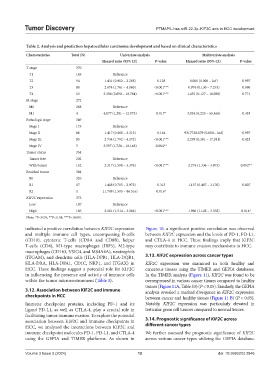
            Table 2. Analysis and prediction hepatocellular carcinoma development and based on clinical characteristics
            Characteristics    Total (N)            Univariate analysis                Multivariate analysis
                                             Hazard ratio (95% CI)  P‑value     Hazard ratio (95% CI)  P‑value
            T stage              370
             T1                  183             Reference
             T2                      94      1.431 (0.902 – 2.268)  0.128         0.000 (0.000 – Inf)   0.997
             T3                      80      2.674 (1.761 – 4.060)  <0.001***    0.974 (0.130 – 7.293)  0.980
             T4                      13      5.386 (2.690 – 10.784)  <0.001***   1.432 (0.127 – 16.098)  0.771
            M stage              272
             M0                  268             Reference
             M1                      4       4.077 (1.281 – 12.973)  0.017*      3.834 (0.225 – 65.465)  0.353
            Pathologic stage     349
             Stage I             173             Reference
             Stage II                86      1.417 (0.868 – 2.312)  0.164      9317720.879 (0.000 – Inf)  0.997
             Stage III               85      2.734 (1.792 – 4.172)  <0.001***    2.299 (0.301 – 17.581)  0.423
             Stage IV                5       5.597 (1.726 – 18.148)  0.004**
            Tumor status         354
             Tumor free          202             Reference
             With tumor          152         2.317 (1.590 – 3.376)  <0.001***    2.274 (1.336 – 3.873)  0.002**
            Residual tumor       344
             R0                  326             Reference
             R1                      17      1.448 (0.705 – 2.972)  0.313        1.137 (0.407 – 3.176)  0.807
             R2                      1       11.749 (1.595 – 86.516)  0.016*
            KIF2C expression     373
             Low                 187             Reference
             High                186         2.161 (1.514 – 3.084)  <0.001***    1.966 (1.148 – 3.368)  0.014*
            Note: *P<0.05; **P<0.01; ***P<0.001.

            indicated a positive correlation between KIF2C expression   Figure 10, a significant positive correlation was observed
            and multiple immune cell types, encompassing B-cells   between KIF2C expression and the levels of PD-1, PD-L1,
            (CD19), cytotoxic T-cells (CD8A and CD8B), helper   and  CTLA-4  in HCC. These  findings  imply  that KIF2C
            T-cells (CD4), M1-type macrophages (IRF5), M2-type   may contribute to immune evasion mechanisms in HCC.
            macrophages (CD163, VSIG4, and MS4A4A), neutrophils
            (ITGAM), and dendritic cells (HLA-DPB1, HLA-DQB1,   3.13. KIF2C expression across cancer types
            HLA-DRA, HLA-DPA1, CD1C, NRP1, and ITGAX) in       KIF2C  expression  was  examined  in  both  healthy  and
            HCC. These findings suggest a potential role for KIF2C   cancerous tissues using the TIMER and GEPIA databases.
            in influencing the presence and activity of immune cells   In the TIMER analysis (Figure 11), KIF2C was found to be
            within the tumor microenvironment (Table 3).       overexpressed in various cancer tissues compared to healthy
                                                               tissues (Figure 11A, Table S3) (P < 0.05). Similarly, the GEPIA
            3.12. Association between KIF2C and immune         analysis revealed a marked divergence in KIF2C expression
            checkpoints in HCC                                 between cancer and healthy tissues (Figure 11 B) (P < 0.05).
            Immune checkpoint proteins, including PD-1 and its   Notably,  KIF2C expression was particularly elevated in
            ligand PD-L1, as well as CTLA-4, play a crucial role in   testicular germ cell tumors compared to normal tissues.
            facilitating tumor immune evasion. To explore the potential
            association between KIF2C and immune checkpoints in   3.14. Prognostic significance of KIF2C across
            HCC, we analyzed the interactions between KIF2C and   different cancer types
            immune checkpoint molecules PD-1, PD-L1, and CTLA-4   We further assessed the prognostic significance of KIF2C
            using the GEPIA and TIMER platforms. As shown in   across various cancer types utilizing the GEPIA database.


            Volume 3 Issue 3 (2024)                         12                                doi: 10.36922/td.2846

